You pay competitively and offer flexibility. Yet good people still leave. The exit interviews reveal frustrations you never saw: no growth path, decisions made without input, the sense that nothing would change.
That departure cost more than a salary. It cost institutional knowledge, client relationships, and the time you will spend rebuilding.
Here is what advisors who retain talent and command premium valuations have figured out: advisory firm culture is not a soft topic. It is an asset that compounds over time, or a liability that does the same. The difference comes down to whether your culture was designed or emerged by accident.
This article covers:
- The difference between culture that happens to you and culture you create
- How buyers evaluate culture when determining what your firm is worth
- What turnover costs beyond the obvious expenses
- Why competitive pay is necessary but never sufficient
- Five elements you can control starting this week
- A diagnostic framework to assess where you stand today
Culture by Default Versus Culture by Design
Culture exists whether you define it or not. The only question is whether it serves your goals.
Culture by default emerges from accumulated habits, unspoken expectations, and however things happened to develop. It might work, or it might actively undermine you. Either way, you did not choose it.
Culture by design means making deliberate decisions about how your firm operates, communicates, develops people, and makes decisions. It requires intention and maintenance, but it produces predictable results.
Gino Lavorgna, who grew his Tampa team from 30 to 72 people in two and a half years, describes what design looks like in practice:
We created a structure that reaches everybody. We offer classes in the morning and in the evening because people's schedules are different. It ensures that we stay rooted in our systems and repeat them constantly.
That is not accidental. It is engineered.
Tommy Nickerson, who built his Jacksonville team from zero to 76 people and now oversees more than 400 advisors, puts it simply:
I always answer my phone. Saturday morning, I'm at my kid's soccer game, and somebody calls me, I'm going to pick up. And the reason I do that is that I want them to always know that I'm available to them.
How Firm Culture Affects Advisory Practice Valuation
If culture feels like a “soft” topic, consider the hard numbers.
According to Advisor Growth Strategies research, median EBITDA multiples for RIA transactions hit 11.0 in 2024. But multiples vary dramatically based on firm characteristics. Practices with strong growth trajectories, proven retention, and leadership depth regularly command multiples in the mid-teens, while firms dependent on a single producer with high turnover may struggle to reach 7x.
What separates those outcomes? A buyer evaluating your firm asks questions that trace directly back to culture:
- If the founder steps back, does the team keep performing?
- Will key people stay through the transition?
- Is knowledge documented or does it live in one person's head?
- Can this firm continue growing without the current owner driving everything?
A firm where the answers are uncertain presents risk. Risk compresses multiples.
For a practice generating $1 million in annual EBITDA, the difference between a 7x and 15x multiple is $8 million in enterprise value. Culture does not show up on your balance sheet, but it determines what a buyer will pay for everything that does.
The True Cost of Employee Turnover in Advisory Firms
When a key team member leaves, the invoice is larger than most owners realize.
Direct costs include recruiting fees, job postings, interview time, and onboarding. Those alone typically run 50 to 75 percent of the departing employee’s annual salary. But the indirect costs often exceed the direct ones.
Consider what walks out with that person: client relationships built over years, institutional knowledge about your systems and processes, and the training investment you made. Factor in the productivity gap while the new hire gets up to speed, the burden on remaining staff who absorb extra work, and the potential for clients to follow their advisor out the door.
Industry estimates place total replacement cost at 1.5 to 2 times annual salary for professional roles. For a $90,000 employee, that means $135,000 to $180,000 in real cost per departure.
Now multiply that by however many people you have lost in the past three years.
Why Compensation Alone Cannot Solve Financial Advisor Retention
If paying more solved retention, the firms with the biggest checkbooks would never lose anyone. They do.
Compensation gets people in the door and keeps them from being poached for purely financial reasons. But when talented people leave firms that pay well, they cite reasons that have nothing to do with money:
- No clear path forward in their career
- Feeling disconnected from leadership and decisions
- Lack of investment in their development
- Bureaucracy that prevents them from doing good work
- Values misalignment with how the firm operates
These are culture problems wearing different masks. You cannot pay your way out of them because money does not address the underlying issue.
The inverse is also true. People will accept less compensation to work somewhere they believe in, where they see a future, and where they feel valued beyond their production numbers.
Five Elements That Shape Advisory Team Culture
Communication Rhythms
How information flows determine how connected people feel. This includes meeting cadence, one-on-one frequency, transparency about firm performance, and how decisions get communicated.
Firms with strong cultures have predictable rhythms. People know when they will hear what, and from whom.
Growth Paths
Talented people want to know where they can go. If the only path forward is owning their own practice someday, you will lose those who want to grow without leaving.
Gino Lavorgna frames this as removing false choices:
They don't have to go out and start their own firm to become a business owner. They can be a leader within a business and build a team.
Decision Rights
Who gets to decide what, and how much latitude people have in their roles, signals trust. Micromanagement communicates distrust. Appropriate autonomy communicates respect for competence.
The balance matters. Too little autonomy suffocates people. Too much creates chaos. The goal is expanding decision rights as people demonstrate capability.
Recognition Practices
What gets celebrated gets repeated. If you only recognize revenue production, you signal that nothing else matters. If you recognize mentorship, collaboration, and client outcomes, you signal a broader definition of contribution.
Recognition does not require elaborate programs. Consistent acknowledgment in team settings, specific praise for specific behaviors, and visibility for contributions beyond production all reinforce what you value.
Development Investment
Whether the firm invests in growing people’s capabilities sends a message about whether this is a place to build a career or just collect a paycheck.
Tommy Nickerson describes his approach:
It's not about me creating people that follow my lead. It's about me developing leaders that go out and develop their own leaders.
The Compounding Nature of Culture
Culture does not produce linear returns. It compounds.
Strong culture improves retention. Better retention preserves institutional knowledge. Preserved knowledge enables consistent client experience. Consistent experience generates referrals. Referrals accelerate growth. Growth funds further investment in people. The cycle reinforces itself.
Weak culture produces the opposite spiral. Departures trigger more departures. Knowledge gaps create service inconsistency. Inconsistency damages reputation. Reputation problems slow growth. The cycle accelerates downward.
Tommy Nickerson captures the difference between isolation and interdependence:
There's a difference between being independent and actually having interdependence. Independence, to me, looks like a tree by itself out in the field. Yeah, it might survive, but when you get that big storm coming through, that tree is coming down. When you have interdependence, you have a forest of trees that protects one another.
How to Assess Your Current Advisory Firm Culture
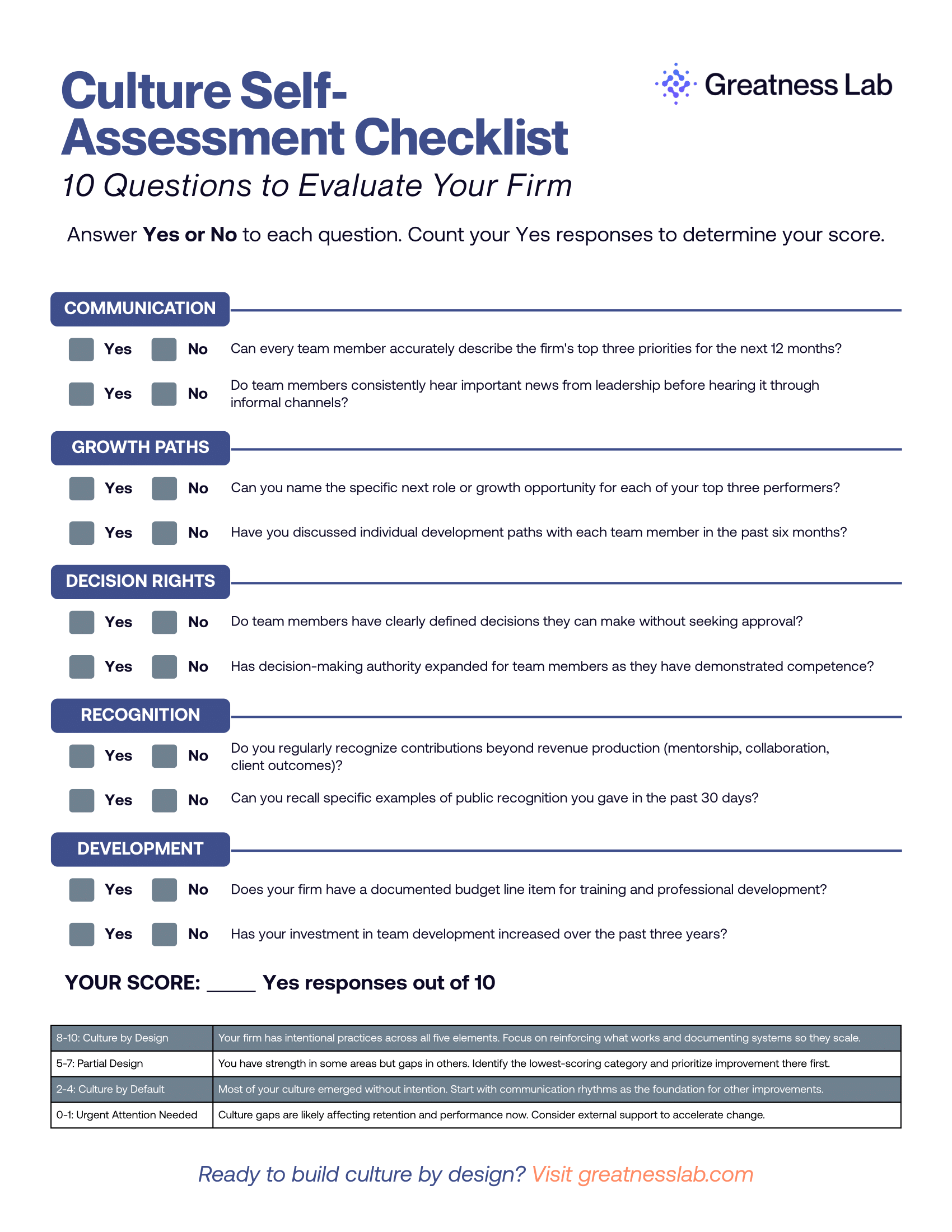
Before you can improve culture, you need an honest read on where you stand. These diagnostic questions help:
On retention: When was your last voluntary departure, and what did the exit interview reveal? Do you know why people stay, not just why they leave?
On communication: Could any team member accurately describe the firm’s priorities for the next twelve months? Do people hear important news from leadership or through the grapevine?
On growth: Can you name the specific next role for each of your top performers? Have you discussed their development path with them directly?
On decision-making: What decisions can team members make without approval? Has that authority expanded as people have proven themselves?
On development: What percentage of payroll do you invest in training and development? How does that compare to what you spent three years ago?
Honest answers reveal whether you have a culture you designed or one that happened to you.
Want to see where you stand? Download the Culture Self-Assessment Checklist – a one-page diagnostic with 10 yes/no questions across all five elements. Score yourself in two minutes and know exactly where to focus first.
Building a Firm Worth Joining
Culture is not separate from business strategy. It is business strategy.
The advisors who build firms worth joining understand that retention drives profitability, leadership depth drives valuation, and intentional culture drives both. They invest in their people not because it feels good but because it compounds into enterprise value.
If your honest assessment reveals gaps between where you are and where you want to be, the question becomes what support and structure would help you close them. Some advisors figure it out alone. Many find that being part of a community with shared systems, development resources, and leadership frameworks accelerates the process considerably.
Greatness Lab exists for advisors ready to build firms worth joining. Our platform provides the leadership development, operational systems, and peer community that help you create culture by design rather than by accident. You keep full ownership of your practice while gaining access to the infrastructure that makes intentional culture possible at scale.
READY TO BUILD A FIRM WORTH JOINING?
Discover how Greatness Lab [link to platform page] helps advisors build culture that compounds.
Key Takeaways
- Culture by design beats culture by default because intentional choices compound over time
- Five elements you control: communication rhythms, growth paths, decision rights, recognition, development
- Turnover costs 1.5 to 2 times salary; the real loss is institutional knowledge
- Buyers pay premium multiples for firms with leadership depth and teams that stay
- Honest self-assessment reveals whether your culture was designed or just happened
Frequently Asked Questions About Advisory Firm Culture
What Is the Most Important Element of Advisory Firm Culture?
How Long Does It Take to Change Advisory Firm Culture?
Can Small Advisory Firms Compete With Larger Firms on Culture?
What Are the Warning Signs of a Culture Problem in an Advisory Firm?
How Do Compensation and Culture Work Together to Retain Advisors?
About the Author
Tommy Nickerson is a Senior Vice President and Advisor at Florida Financial Advisors in Jacksonville, Florida. He leads high-performing advisory teams, focusing on aligning wealth with purpose while developing the next generation of leaders and markets. Connect with Tommy on LinkedIn: https://www.linkedin.com/in/tnickerson/