
You built something impressive. Great clients who trust you. A healthy income that puts you in the top tier of earners. The respect of your peers. By every conventional measure, you made it.
So why does it feel like a trap?
The answer is simple, even if it stings to admit. You built a practice, not a business. Your clients came to you because of you. Your revenue depends on you showing up every day. Step away for six months and most of what you built evaporates.
This is the golden cage. High income with no equity. Prestigious title with no exit. Years of work that cannot sell for what it actually deserves. You own a job you created, not an asset you can transfer.
There is a way out. But it requires understanding the difference between what you built and what you could build.
In this article, you will learn:
The valuation gap between a practice and a business (and why buyers pay 2-3x for one and 5-9x for the other)
The warning signs that you have hit your ceiling
What the transition from producer to business owner actually requires
Why most advisors cannot make this shift alone
How to evaluate whether your current structure allows real ownership
There is a way out. But it starts with understanding exactly where you are stuck.
The Difference Between a Practice and a Business
The distinction shows up in your valuation.
Solo advisory practices typically sell for two to three times revenue. Sounds reasonable until you compare it to structured advisory businesses. Firms with documented systems, trained teams, and transferable client relationships command five to nine times EBITDA. Premium firms with strong infrastructure get even higher multiples.
Why the gap? Buyers pay for certainty. A practice that depends entirely on its founder carries acquisition risk. When the founder leaves, the clients might follow. Buyers discount for that uncertainty.
A business has value independent of any single person. The systems run whether you show up or not. The client experience stays consistent because processes drive it, not heroic individual effort. The team serves clients without you making every decision.
Most advisors call their practice a business. The market knows the difference. So do buyers.
Signs You Hit the Ceiling in your Advisory Practice
The golden cage builds gradually. By the time you notice, you have been stuck for years.
Your income plateaued despite working harder. You added clients, expanded services, upgraded technology. Yet you run on the same treadmill, moving faster to stay in place. The math fails because you are the bottleneck. Every new client requires more of your time, and you have no more time to give.
You cannot take a real vacation. Sure, you can disappear for a week if you check email constantly and handle emergencies remotely. True disconnection? Impossible. Things fall apart when you leave because everything runs through you.
You talk about your exit for years without making progress. Someday you will figure out succession. Someday you will build that team. Someday you will document those processes. But someday never comes because today’s client work always takes priority.
You carry all the risk but own no equity. You built the client relationships. You created the revenue. But you hold no ownership stake beyond your own production. If something happens to you, your family gets nothing from the practice you spent decades building.
If this sounds familiar, you are not failing. You succeeded at building a practice. The problem is that a practice has a ceiling, and you hit it.
What the Transition to True Business Ownership Requires
Moving from practice and production to business is not a side project. It demands fundamental changes in how you think about your work.
The Mindset Shift
You built your practice by being the best producer. That skill got you here. It will not get you to the next level.
The transition requires shifting from doing the work to enabling others to do the work. From being the rainmaker to building an organization that makes rain without you.
This is harder than it sounds. Your identity wrapped itself around being the one clients want. Letting go feels like abandoning what made you successful. But holding on is exactly what keeps you stuck.
Building Systems That Outlast You
Buyers pay premium valuations for documented, standardized processes. Not because they love paperwork, but because documented systems prove the business operates without its founder.
Start with your client experience. Can someone else deliver it consistently? If the answer is no, you do not have a business. You have a set of relationships that happen to generate revenue.
The goal is operational efficiency that makes your practice more appealing to a buyer and, more importantly, creates capacity for growth. You cannot scale what only exists in your head.
Developing Leadership Skills
The skills that make a great producer differ from the skills that make a great leader. You never trained for this. Most advisors never did. The industry teaches production, not leadership.
Leadership means developing people [link to leadership development], not just managing tasks. It means creating clarity and accountability. It means making decisions for the organization’s success, not just your own book. These are learnable skills, but they require intentional development.
Finding the Right Structure
Not every structure lets you build transferable value. Some platforms treat you as a producer, not an owner. You bring in revenue, they take their cut, and you walk away with nothing when you leave.
The right structure offers a path to ownership. It aligns incentives so your success builds equity, not just income. It provides infrastructure and support to help you make the transition without building everything from scratch.
This is where true partnership matters. A vendor processes your transactions. A partner invests in your growth and gives you a stake in what you build together.
The Exit Question
Here is the uncomfortable truth. Over 109,000 advisors plan to retire in the next decade. That represents more than a third of industry headcount and over 40 percent of total assets under management. Yet one in four of those advisors still has no succession plan.
Eighty percent of businesses never sell. Not because owners do not want to sell, but because they never built anything that could be sold. They spent decades creating income and zero years creating transferable value.
The exit question shapes every decision you make now. What are you building toward? If the answer is “I will figure it out when I am ready to retire,” you are already behind.
Enterprise value requires intentional decisions made years in advance. Recurring revenue structures. Documented processes. Trained teams. Diversified client bases. These are not things you bolt on at the end. They get built into the foundation.
The advisors who build real wealth do not just grow revenue. They build assets. The difference between a two-times-revenue exit and a seven-times-EBITDA exit is not luck. It is architecture.
Why Independence Without Interdependence Is Another Trap
Going independent sounds appealing. Keep more of your revenue. Build on your terms. Answer to no one.
But here is what nobody tells you: independence often just trades one cage for another. You escape the corporate structure only to become the entire infrastructure yourself. Compliance. Technology. Marketing. Recruiting. Training. HR. Every function that used to be handled for you now lands on your desk.
This is why true business ownership is not about independence. It is about interdependence.
Interdependence means plugging into a platform that handles the operational complexity while you retain ownership of what you build. It means accessing shared resources, mentorship, and infrastructure without sacrificing equity. It means your success benefits from the collective strength of the organization, and the organization benefits from your success.
Why Most Advisors Cannot Do This Alone
The advisors who successfully transition from practice to business rarely do it alone. They find structures where they participate in the upside. Where they build equity alongside income. Where their success compounds into something transferable because they are part of something larger than themselves.
How to Evaluate Whether Your Current Structure Allows Real Ownership
Most advisors assume they are building equity. Few have actually tested that assumption. Before you invest another year in your current structure, answer these questions honestly.
The Ownership Reality Check
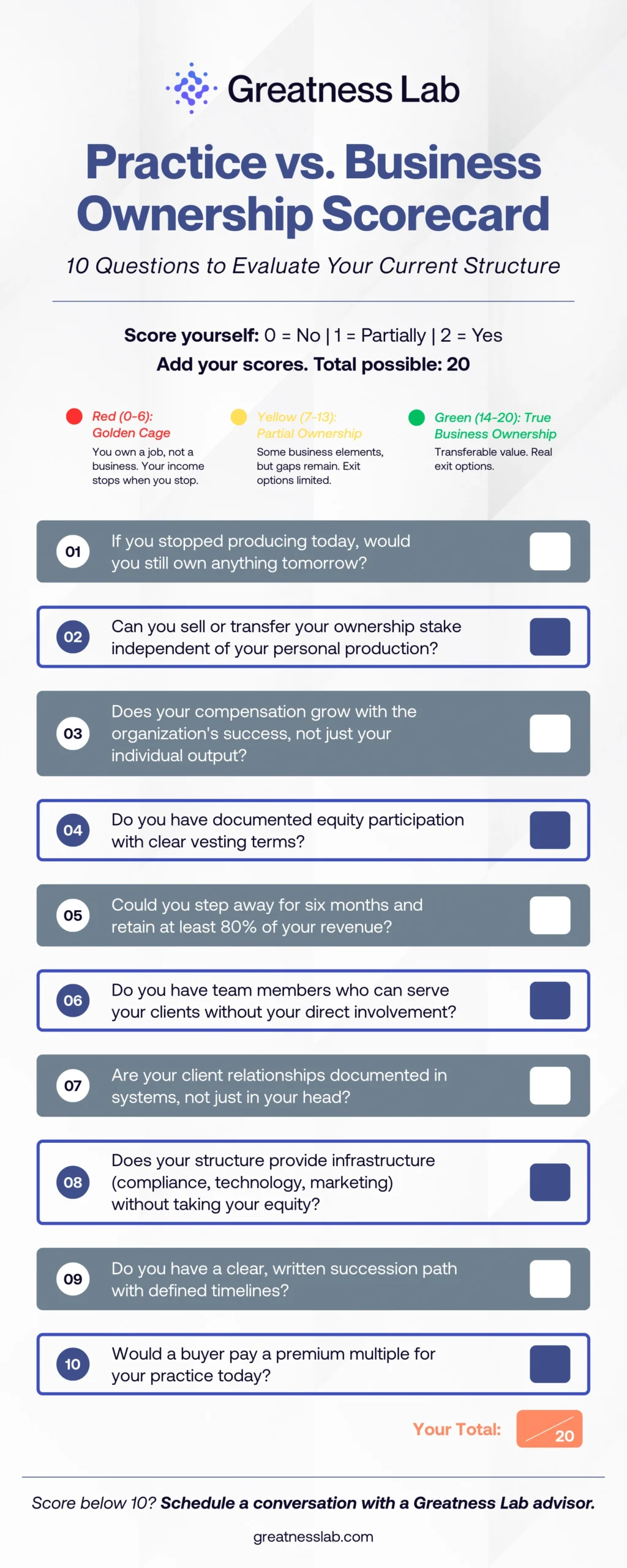
- If you stopped producing today, would you still own anything tomorrow?
- Can you sell or transfer your ownership stake independent of your personal production?
- Does your compensation grow with the organization's success, not just your individual output?
- Do you have documented equity participation with clear vesting terms?
- Could you step away for six months and retain at least 80% of your revenue?
- Do you have team members who can serve your clients without your direct involvement?
- Are your client relationships documented in systems, not just in your head?
- Does your structure provide infrastructure (compliance, technology, marketing) without taking your equity?
- Do you have a clear, written succession path with defined timelines?
- Would a buyer pay a premium multiple for your practice today?
- 0-6: Golden Cage. You own a job, not a business. Your income stops when you stop. Most of what you built cannot be sold or transferred.
- 7-13: Partial Ownership. You have some elements of a business, but significant gaps remain. Your exit options are limited and your valuation is discounted.
- 14-20: True Business Ownership. You built transferable value. Your structure rewards equity, not just production. You have real exit options.
What Your Score Reveals
If you scored below 10, you are not alone. Most advisors operate in structures that reward production but prevent ownership. The industry is designed this way. High payouts keep you producing. Lack of equity keeps you dependent.
The question is not whether your score is low. The question is whether your current structure can ever get you above 14. Some platforms have no path to ownership no matter how long you stay. Others are designed specifically to help you build transferable value from day one.
Understanding the gap between where you are and where you need to be is the first step. The second step is finding a structure that can actually close that gap.
Transitioning From Advisor Practice to Business: Questions and Answers
What does equity participation actually mean for advisors?
How do I evaluate whether my current structure allows real ownership?
What is the first step if I want to start this transition?
Breaking Free: Start Your Transition From Practice to Business Owner
The golden cage is comfortable. That is what makes it dangerous. You can spend an entire career inside it, earning well and serving clients, without ever building something that outlasts your daily effort.
The advisors who escape do not just work harder. They build differently. They find structures that reward ownership, not just production. They develop systems that create value independent of their personal involvement. They make the transition from practitioner to entrepreneur.
If you are ready to explore what that looks like, start with an honest conversation about where you are and where you want to be. Not a sales pitch. Not a recruiting call. Just a straightforward discussion about whether the structure you are in can get you where you want to go.
Schedule a conversation with a Greatness Lab advisor who made this transition.