
Five or ten years into your practice, you will either have a business someone wants to buy or a job that ends when you stop working. The difference is not luck. It is a series of decisions that start in year one.
Most advisors discover this too late. They build revenue first and worry about business structure later. By the time they think about selling, they realize they have nothing transferable to sell.
This article covers what exit-minded advisors build early:
- Revenue quality that commands premium valuations
- Client diversification that reduces buyer risk
- Documentation that makes your business transferable
- A structure that operates without you
- Financial clarity that survives due diligence
The Backward Build Most Advisors Fall Into
The typical advisor trajectory looks like this: get clients, generate revenue, figure out systems later. This approach works for income. It fails for enterprise value.
Buyers do not purchase your client list. They purchase a business that will continue generating revenue after you leave. If your practice depends on your personal relationships, your knowledge, and your daily involvement, there is nothing for a buyer to acquire except risk.
Buyers are not purchasing access to you. They are purchasing a business. If those are the same thing, you have a problem.
According to Pareto Systems research, the core question buyers ask is simple: “Can you leave for two months and it runs fine?” Most advisors cannot answer yes.
The Builder's Mindset
Five or ten years into your practice, you will either have a business someone wants to buy or a job that ends when you stop working. The difference is not luck. It is a series of decisions that start in year one.
Most advisors discover this too late. They build revenue first and worry about business structure later. By the time they think about selling, they realize they have nothing transferable to sell.
This article covers what exit-minded advisors build early:
- Revenue: Not just how much, but how predictable and transferable
- Clients: Not just how many, but how concentrated the risk
- Operations: Not just whether it works, but whether someone else could run it
- Finances: Not just whether you are profitable, but whether a buyer can verify it
Whether you are starting fresh or realizing mid-career that your practice needs restructuring, these foundations determine whether you build wealth or just income.
The Backward Build Most Advisors Fall Into
The typical advisor trajectory looks like this: get clients, generate revenue, figure out systems later. This approach works for income. It fails for enterprise value.
Buyers do not purchase your client list. They purchase a business that will continue generating revenue after you leave. If your practice depends on your personal relationships, your knowledge, and your daily involvement, there is nothing for a buyer to acquire except risk.
Buyers are not purchasing access to you. They are purchasing a business. If those are the same thing, you have a problem.
According to Pareto Systems research, the core question buyers ask is simple: “Can you leave for two months and it runs fine?” Most advisors cannot answer yes.
The Year-One Foundation That Creates Enterprise Value
Exit value is not determined in the year you sell. It is built through decisions made years earlier. The advisors who command premium multiples made five foundational choices that compounded over time.
Build recurring revenue before you need it
Revenue quality matters more than revenue quantity. Transaction-based revenue creates income. Recurring revenue creates value. Buyers pay for predictable cash flows they can count on after you leave. According to Advisor Legacy valuation data , practices with 85% or more recurring revenue command multiples of 2.0x to 3.5x revenue, while transaction-heavy practices often struggle to find buyers at any price.
Recurring revenue is not just about stability. It is about what a buyer can count on being there after you leave.
The choice to build recurring revenue must be made early because converting an existing transaction-based practice is difficult. Clients accustomed to paying per transaction resist ongoing fees. Building with recurring revenue from the start avoids this conversion problem entirely.
Diversify your revenue before concentration becomes risk
Client concentration signals risk to buyers and lenders. When a small number of clients represent a large portion of revenue, losing any one of them threatens the business. Buyers discount heavily for this risk, and lenders may refuse to finance acquisitions where concentration is too high. According to research from Unbroker and eCapital, lenders and buyers use these concentration thresholds:
- Low risk: No single client exceeds 10% of revenue
- Moderate risk: Top client is 10-20% of revenue
- High risk: Top client exceeds 20% of revenue
- Critical risk: Top 5 clients represent more than 25% of total revenue
High concentration does not just lower your valuation. It can disqualify you from financing entirely. Buyers who need loans to acquire your practice may not get approved if your revenue depends on a handful of clients who could leave.
Concentration risk is not just about valuation. It affects whether buyers can get financing to acquire your practice at all.
The year-one decision: Track concentration ratios quarterly. If you see a client approaching 10%, actively pursue diversification before it becomes your brand.
Document your business as if you are leaving tomorrow
If it is not documented, it is not transferable. Your service model, client onboarding process, annual review workflow, and recurring tasks need to exist in written form that someone else could follow.
The test is practical: Could a new team member deliver your service model from documentation alone? Could another advisor step into your systems quickly?
Documentation is not bureaucracy. It is the difference between selling a business and selling a client list with your phone number attached.
The year-one decision: Document as you build. Every process you create should have a written version from the start. Waiting until you want to sell means reconstructing years of accumulated knowledge under pressure.
Build a business that runs without you
Founder dependence is a value destroyer. According to buyAUM research. If you are the firm, you do not have a firm. You have a high-paying job that becomes worthless the day you stop showing up.
Building founder independence requires:
- Client relationships with your firm, not just you: Clients should know and trust other team members
- Decision-making that does not require you: Team members should handle routine decisions without your approval
- Revenue from multiple sources: Production should come from systems or multiple team members, not just your personal efforts
The year-one decision: Build with the assumption that you will not always be the one doing the work. Every client relationship, every process, every decision point should be designed for someone else to eventually handle. Replicating yourself and building your leadership development prowess become more important to your business.
Create visibility into your numbers
Buyers need to verify what you claim. Clean, auditable financials are not optional. Commingled personal and business accounts, inconsistent categories, and missing records create doubt that kills deals.
Financial clarity means:
- Complete separation of business and personal finances
- Consistent accounting categories across years
- Revenue tracked by source and client
- Profit margins you can explain and defend
The year-one decision: Set up proper accounting from day one. The cost of clean books is minimal compared to the value lost when buyers cannot trust your numbers.
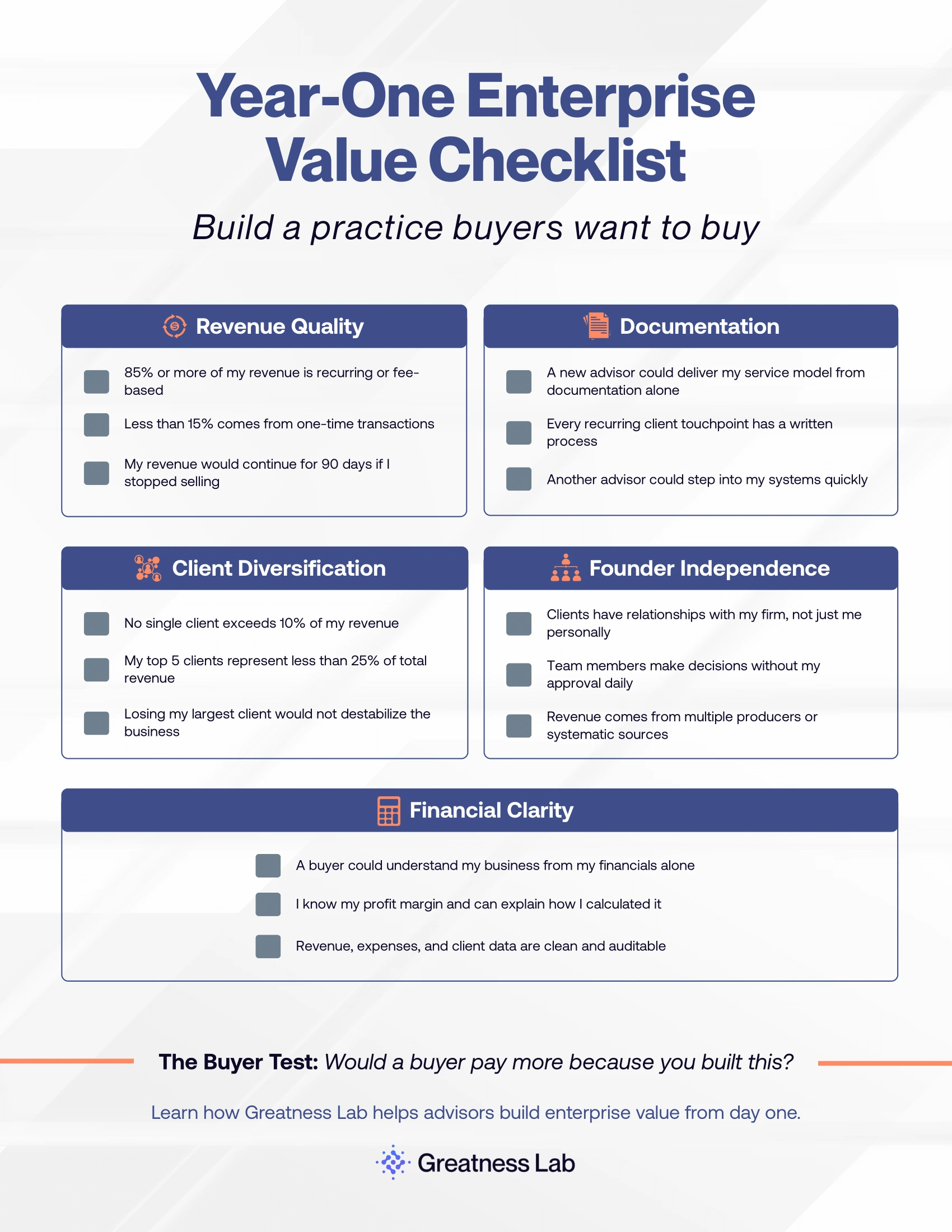
Download the Year-One Enterprise Value Checklist to assess where your practice stands today.
The Mid-Career Fix
If you are reading this mid-career and realizing your practice lacks these foundations, you are not starting from zero. You have revenue, clients, and operational knowledge. What you need is structure.
The mid-career fix requires honesty about what exists and what does not:
- Revenue mix: What percentage is actually recurring? What would it take to shift the balance?
- Concentration: Who are your top 5 clients by revenue? What percentage do they represent?
- Documentation: If you were hit by a bus tomorrow, what would your team be able to continue without you?
- Founder dependence: How many decisions require your personal involvement daily?
- Financial clarity: Could a buyer verify your numbers in due diligence?
The answers determine your roadmap. Some advisors need six months of focused restructuring. Others need two years. The timeline matters less than the direction.
What Buyers Actually Evaluate
Understanding what buyers examine helps clarify what to build. Buyers evaluate practices across several dimensions, each affecting the multiple they will pay.
Revenue quality matters more than revenue size. A practice generating $500,000 in recurring fees from diversified clients is more valuable than one generating $800,000 from transaction commissions concentrated in a handful of relationships.
Client demographics affect future revenue projections. Practices serving clients who are 75 years old face attrition risk that younger client bases do not. Buyers discount for age-related runoff.
Transition risk determines deal structure. High-risk transitions result in longer earnout periods and more contingent payments. Low-risk transitions allow buyers to pay more upfront.
Growth trajectory signals future potential. Practices showing consistent growth command premiums over those that are flat or declining, even if current revenue is similar.
Each of these factors is within your control. Building a sellable practice means making decisions that optimize across all of them, not just the ones that are easiest to address.
The Valuation Gap: Why Similar Practices Sell for Different Multiples
Two practices with identical revenue can sell for dramatically different prices. The difference is not market timing or negotiation skill. It is the structural characteristics described above.
A practice with recurring revenue, diversified clients, documented operations, founder independence, and financial clarity might sell for 2.5x to 3.5x revenue. A practice with transaction revenue, concentrated clients, undocumented operations, founder dependence, and disorganized financials might struggle to sell at 1.0x revenue, if it sells at all.
This gap represents years of different decisions compounding over time. Closing the gap requires making different decisions starting now and maintaining them consistently until exit.
How Greatness Lab Approaches Enterprise Value
Greatness Lab was built by founders who have already created and sold a valuable business. Jason and Allyson Mickool scaled from 2 people to over 700 advisors across 6 regional brands in 8 years, creating enough value for AmeriLife to acquire 60% of the business.
Their platform [NOTE: link to GL Platform page] treats enterprise value as a design problem, not an afterthought. Operational playbooks, documentation systems, and leadership development are built into how advisors work from day one.
The approach is practical: repeatable systems, clear roles, a leadership bench, and a simple operating rhythm. These are the foundations that created transferable value once, and they form the core of how Greatness Lab helps advisors build today.
Key Takeaways
- Revenue quality matters more than quantity. Target 85% or higher recurring revenue.
- Diversify before concentration becomes risk. No single client should exceed 10%.
- Document everything. If it is not written down, it is not transferable.
- Build founder independence. The business should run without you.
- The characteristics that create sellable value are the same characteristics that create better businesses to own and operate.
Building a sellable practice is a choice made through thousands of small decisions over years. Each decision either adds to your eventual exit value or subtracts from it. The advisors who achieve premium valuations are not luckier or smarter. They simply made different decisions, earlier, and maintained them longer.
Common Questions About Building a Sellable Advisory Practice
What makes a financial advisory practice valuable to buyers?
Buyers pay for predictable, transferable revenue. The most valuable practices have 85% or higher recurring revenue, diversified client bases with no single client exceeding 10% of revenue, documented processes that anyone could follow, and operations that do not depend on the founder. Buyers are purchasing a business that will continue generating revenue after the owner leaves, not a client list attached to one person’s relationships.
What multiple do financial advisory practices sell for?
According to Advisor Legacy and Peak Business Valuation research, advisory practices typically sell for 2.0x to 3.5x revenue or 4x to 8x EBITDA. Practices with 85% or higher recurring revenue command the top of these ranges. Practices with transactional revenue, high client concentration, or founder dependence sell at significant discounts or may not attract buyers at all.
What reduces the value of an advisory practice?
Four factors consistently reduce practice value: high client concentration (top 5 clients exceeding 25% of revenue), founder dependence (the owner is the only client relationship), poor documentation (processes exist only in the owner’s head), and unreliable financials (commingled accounts, inconsistent records). Any of these can disqualify a practice from financing or eliminate buyer interest entirely.
What documentation do I need to sell my advisory practice?
Sellable practices have written documentation for client onboarding, annual review workflows, recurring service tasks, and operational procedures. The test is whether a new team member could deliver your service model from documentation alone. Buyers also require clean financial records, client agreements, and compliance documentation. Practices without written processes are selling a client list, not a business.
About the Author
David Globke has spent his career advising financial professionals on practice development and succession planning. He is the founder and CEO of Lat Wealth. His work focuses on helping advisors build businesses that create lasting value for themselves, their clients, and their teams.