Most established insurance and financial advisors pay for some form of coaching. A quarterly mastermind. A producer-group membership. A one-on-one engagement with a coach they met at a conference. Some of these produce real changes in business. Others deliver motivation dressed up as coaching. The gap between the two is hard to see from inside the relationship.
This article defines what coaching for financial advisors delivers when it is working, what separates a coach who is helping a practice owner from a coach who is occupying a calendar slot, and gives the reader a five-dimension scorecard to evaluate their situation. The goal is to help a practice owner decide whether to keep, adjust, or change what they have.
Key Takeaways
- Coaching for financial advisors is a broad category. The right coach depends on what the practice owner is solving for: clarity, accountability, leadership skill, team building, or strategic direction.
- Real coaching produces structural change in the business. New decisions, new systems, new conversations the owner would have missed alone.
- A coach, a mentor, and a consultant each fill a different need. Hiring the wrong type for the problem wastes money and delays growth.
- A five-dimensional scorecard gives the reader an honest read on whether their current coaching situation is delivering, partially delivering, or falling short
What Coaching for Financial Advisors Delivers
Coaching works on a specific set of outcomes. The International Coaching Federation has published research showing business coaching produces an average return of seven times the program cost. That return comes from a few observable outputs:
- Clarity on the next right move. Practice owners operate with more options than bandwidth. A coach helps the owner narrow the field and commit to one path instead of hedging across three.
- An external perspective that cuts through tunnel vision. When the owner is the business, the business becomes invisible to the owner. A coach sees what the owner cannot.
- Accountability that produces action. Most practice owners already know what they need to do and still do not do it. Coaching closes the gap between knowing and doing through structured accountability.
- Leadership and decision-making skills. The skills that build personal production differ from the skills that lead a team. Coaching develops a new skill set as practice grows.
- A sounding board for decisions the owner would otherwise make alone. Entrepreneurship is isolating. Research on why business owners seek coaching consistently names the sounding-board function as one of the highest-value outcomes.
Coach Micheal Burt teaches what Ken Coleman called the Proximity Principle: you become the average of the people you spend the most time around. Coaching is one of the strongest levers a practice owner has in that environment. For the broader context on mindset and proximity, see Inside the Mind of a Monster.
Financial Advisor Coach vs Mentor vs Consultant: Which One You Need
One of the most common mistakes a practice owner makes is hiring the wrong type of support for the problem they are facing. A coach, a mentor, and a consultant each fill a different role.
Coach Helps You Develop Capability
A coach uses structured questions to help the owner work through a problem and build the decision-making skill to handle similar problems in the future. A coach asks better questions than the owner is asking alone. Coaching produces long-term capability and takes longer than other forms of support.
Mentor Shares Experience
A mentor has lived through what the owner is facing and shares lessons from direct experience. The value of mentorship is speed. The trade-off is that what worked in the mentor’s business may translate imperfectly to the owner’s business.
Consultant Diagnoses and Delivers
A consultant is hired for a specific project with a specific deliverable: redesign a compensation plan, restructure a recruiting pipeline, produce a valuation analysis. The consultant brings expertise, produces results, and hands it off. The risk is dependency on external expertise instead of building it internally.
Most established practice owners benefit from a blend: a coach as the long-term relationship that builds capability, a mentor for specific stage transitions where lived experience shortcuts the learning curve, and a consultant for project-based needs that require expertise the owner does not need to build. The real question is which type fits which problem.
For practice owners evaluating where they are in their career arc, the Three Stages framework provide useful context on what kind of support fits each stage.
What Makes a Good Business Coach for Entrepreneurs and Practice Owners
The research on effective coaching for entrepreneurial business owners converges on a consistent set of qualities. When evaluating a coach, look for these five:
- Real experience in problems close to yours. The best coaches have operated at or above the level the owner is trying to reach. Direct experience solving similar problems in similar businesses produces advice that applies to the owner’s situation.
- Questions that are harder than the ones you ask yourself. A coach who asks harder questions than the owner is comfortable answering is earning the fee. The quality of the questions is the clearest real-time signal of coaching quality.
- Accountability structure that produces action. Effective coaching includes a mechanism for tracking what the owner committed to and what they did. Regular check-ins. Progress reviews. Tracked targets. Advice that lacks accountability dissolves before the next session.
- Willingness to share their own failures. The best coaches tell the owner where they were wrong, what they would do differently, and which lessons cost them to learn. That honesty is where real value lives.
- An approach built around your business. A good coach listens first and builds the engagement around the specific business, the specific owner, and the specific stage. The approach adapts as the owner and the business change.
These qualities map directly to the habits that define top-producing financial advisors. For practice owners ready to explore structured coaching built on direct operating experience, Growth Acceleration is built around these qualities.
The Coaching Scorecard for Insurance and Financial Advisors
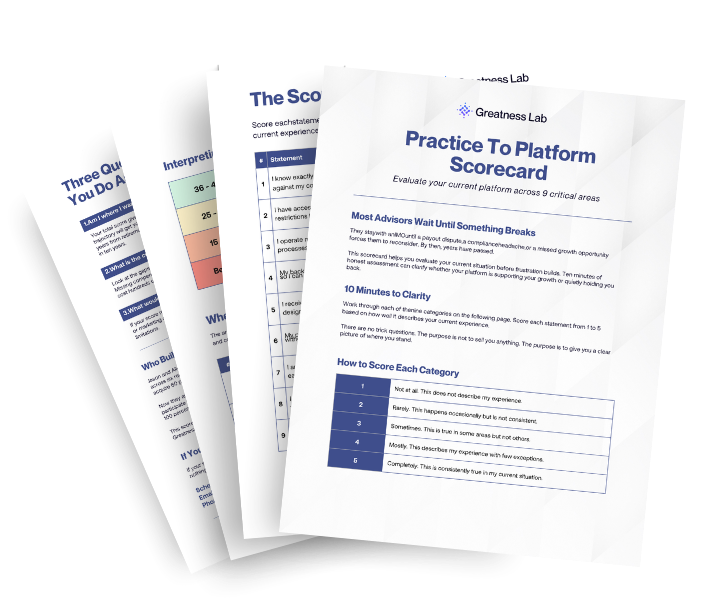
Use this scorecard to evaluate the coaching situation you are in right now. Five dimensions, two yes or no questions per dimension. Ten in total. The scorecard works only if the answers are truthful.
Dimension 1: Relevance of the Coach's Experience to Your Situation
- Has this coach personally built, led, or advised in a business context close enough to mine that their experience directly applies to my problems?
- Can my coach speak with specificity about the operational challenges my business is facing right now?
Dimension 2: Quality of the Questions and Challenges
- Does my coach ask questions that make me think harder than I would on my own?
- Does my coach push back on my thinking when I need it?
Dimension 3: Accountability That Produces Action
- Do I leave coaching sessions with specific next steps that I follow before the next conversation?
- Does my coach track what I committed to and hold me to it?
Dimension 4: Structural Change in Your Business Over the Last Six to Twelve Months
- Has my coaching produced at least one measurable structural change in my business in the last year (a new system, a new leadership layer, a new process, a new team member, a reorganized calendar)?
- Can I point to at least one specific decision I made in the last year that I would have missed without my coach?
Dimension 5: Fit and Trust
- Do I tell my coach the truth about what is going wrong in my business, or do I edit what I share?
- Do I leave sessions with more clarity and commitment, or with more confusion and obligation?
What Your Score Means
Eight to ten yes answers: coaching is doing its job. Keep investing in the relationship and keep raising the bar on what you bring to it.
Five to seven yes answers: Partial coaching. Some dimensions are working. Others are falling short. Identify the specific dimensions where you answered no and raise them with your coach directly. A good coach welcomes that conversation.
Zero to four yes answers: What you have is failing to deliver coaching value. This is a decision point. Most practice owners outgrow coaches over time. The next step is either a direct conversation with your current coach about what needs to change, or a search for a better fit relationship.
For practice owners whose scorecard reveals the need for a different coaching environment, the GL Community and Collaboration model blends one-on-one coaching with peer accountability, giving owners access to coaches and peers at the same time.
Frequently Asked Questions About Coaching for Financial Advisors
What is the difference between a business coach, a mentor, and a mastermind for a financial advisor?
A business coach works with a practice owner on an ongoing basis to build decision-making and leadership skills through structured questions and accountability. A mentor shares lived experience in specific situations and typically has a looser, less structured relationship. A mastermind is a peer group where practice owners support each other, usually facilitated by a coach or industry expert. Most established financial advisors benefit from a blend of all three across their career: a coach for long-term capability building, a mentor for specific stage transitions, and a mastermind for peer accountability and perspective.
How much should an established financial advisor expect to invest in meaningful coaching?
Real coaching investment for established practice owners ranges from several thousand dollars for short-term group programs up to forty thousand dollars or more for comprehensive one-on-one engagements with coaches who have operated at scale. The right investment depends on the practice’s revenue, the complexity of the challenges, and the level of access the owner needs. The research on return on investment for coaching consistently shows a multiple of the program cost when the coach and the engagement are matched to the owner’s stage.
How do you know when it is time to change financial advisor coaches?
The clearest signal is a low score across multiple scorecard dimensions, especially Dimension 4 (structural change in the business over the last six to twelve months). If there is no measurable change in the business and the owner cannot point to decisions that were shaped by coaching, the relationship is failing to produce coaching value. The next step is a direct conversation with the coach about what needs to change. If that conversation does not produce a different experience within a reasonable time, it is time for a new coach. Most practice owners outgrow coaches as they scale. For context on where coaching fits across the stages of a practice, see how to scale a financial advisory practice.
Can group coaching or a peer mastermind deliver what a one-on-one coach delivers?
Group coaching and peer masterminds deliver different values than one-on-one coaching. The group format provides peer perspective, shared accountability, and exposure to problems other owners are solving. The one-on-one format provides deeper customization, more direct accountability, and conversations about issues an owner will hold back in a group setting. The strongest coaching structures for practice owners combine both: a one-on-one coaching relationship as the backbone, and a peer community as the parallel layer. Group alone often lacks accountability depth. One-on-one alone often lacks the perspective that comes from seeing how other owners are solving similar problems.
Build Coaching Around the Practice You Are Trying to Build
The practice owners who scale and eventually exit on their own terms are rarely the ones with the most natural talent. They are the ones who invested in the right coaching at the right stages, asked harder questions of themselves and their coaches than the average owner is willing to ask, and built the structural change coaching should produce into their business year after year.
If the scorecard reveals gaps, the next step is a decision. Either a direct conversation with the current coach about what needs to change, or a search for a coaching relationship that delivers what the practice needs at this stage.
To explore what that looks like inside the GL community and coaching model, schedule a conversation through Contact Us or learn about the GL Membership structure.
About the Author
Jason Mickool, Founder and CEO of Greatness Lab
Jason Mickool built Florida Financial Advisors from a kitchen table conversation into a national advisor enterprise spanning dozens of locations across more than a dozen states. He completed a nine-figure transaction with AmeriLife and now applies that direct operating experience inside the Greatness Lab coaching and growth ecosystem, working with insurance and financial advisors who want to build, scale, and exit their own practices on their own terms. Connect on LinkedIn
Coach Micheal Burt, Co-Founder of Greatness Lab
Coach Micheal Burt is co-founder of Greatness Lab and founder of The Greatness Factory in Nashville, Tennessee. A former championship basketball coach turned business performance coach, he has worked with tens of thousands of professionals across financial services, healthcare, real estate, and entrepreneurship, and is the author of more than a dozen books including Flip A Switch, Person of Influence, and A to B. Connect on LinkedIn