If your annual insurance agency or financial advisor business plan is trailing its year-to-date milestones, Q4 is a critical window for an independent agency owner to course-correct. How much missing premium revenue you can actively reclaim during this final stretch depends entirely on your team’s current pipeline velocity and your typical policy issuance timelines. Regardless of your current production numbers, executing a focused year end sales push during these remaining weeks determines exactly how you build early operational momentum and set up next year’s insurance practice growth.
When Greatness Lab founders Jason Mickool and Coach Micheal Burt help an independent insurance agency principal reset an underperforming financial advisor business plan, they initiate the turnaround strategy by asking two diagnostic questions: Where exactly did the year slip? And what operational levers can independent agents still change in the weeks left?
In this article, you will learn how to answer both questions and turn those answers into a plan:
- Auditing historic lead metrics, conversion velocities, and producer workflows.
- Isolating pipeline bottlenecks using modern insurance advisor performance tracking tools.
- A functional diagnostics table to match real-world agency symptoms with immediate fixes.
- Enforcing daily targets around six non-negotiable core sales activities.
- Knowing when to scale past your personal limits by implementing automated financial advisor marketing systems.
In this article, you will learn how to answer both questions and turn those answers into a plan:
- Isolate Performance Gaps: Use the formula Activity × Conversion × Case Size to pinpoint exactly where your business plan fell off course.
- Will vs. Skill: A deficit in sales volume indicates an activity problem (will vs skill), whereas a low close ratio indicates a conversion problem.
- Model Week Execution: A successful Q4 reset requires building a fixed weekly schedule around six key activities backed by daily targets.
Reviewing Which Lead Sources and Sales Activities Worked This Year
To successfully reverse a downward trend before the fiscal year ends, an independent insurance agency owner must look past assumptions and evaluate concrete historical numbers. Coach Micheal Burt spent 16 years coaching elite women’s basketball before transitioning his performance frameworks into the corporate sector. During games, one assistant charted every play, and at halftime she told him which ones were working. Then, as he put it, “we would go back in the second half, and we would only run the plays that worked.
You run plays across your independent agency as well, and you can look back at this year’s execution using the historical data locked inside your management systems:
- Which lead sources produced first meetings, and which produced little or nothing?
- What follow-up steps turned a conversation into a second meeting?
- Which kinds of meetings ended in a new client?
- Where did hours go without producing new business?
Independent agents who neglect to track daily activity often discover their business plan is failing when it’s already too late. Without accurate tracking tools, day-to-day operations become purely reactive, turning one poor quarter into a systemic downward trend. By running an in-depth audit on your active carrier books now, you can immediately identify which profitable risk categories to target during your year-end sales push.
Using the Success Formula to Find Why Your Business Plan Is Behind
To diagnose why an independent insurance agency business plan is missing its milestones, look past raw revenue and analyze the mechanics of your book of business. True operational health is governed by a precise success formula:
Activity × Conversion × Case Size = Success
Greatness Lab engineered its calendar-filling and sales-execution systems specifically to optimize the first two components of this equation. When annual production drops below target, applying this formula helps you instantly differentiate between a will vs skill bottleneck:
- An activity problem, which is a question of will. You hold the technical capability to close, but your calendar lacks a sufficient volume of first meetings. If you find your team handles consultations well but simply lacks at-bats, you need to step up your pipeline outreach. In many cases, adding targeted insurance advisor growth services can help fill an empty sales funnel during a critical slowdown.
- A conversion problem, which is a question of skill. Your team is actively taking meetings, but your closing ratios are too low to hit premium targets. Too few of the people you see become clients. Much of that skill shows up in the meeting itself, including knowing why qualified prospects stall and how to help them decide. Implementing the best sales training for insurance agents is one way to close that gap.
Each problem calls for a different fix, so it helps to know which one you have before you change your week. Once activity and conversion are working, you can turn to case size, which is how much each new client relationship is worth.

Low Activity: A Question of Will
The first problem is activity. Are you setting up your calendar each day so you do enough of the work that brings in new clients?
You can miss this problem if your closing rate is high. In one national advisory firm, the planning ratio is about one new client for every five people seen. When someone told its founder, Jason, that they close half the people they see, his answer was, “well, you don’t have enough activity then.” If you close that many, you are probably strong in the meeting and could be seeing more people. When that describes you and the year is behind, booking more first meetings is a good place to start.
Low Conversion: A Question of Skill
The second problem is conversion. You are working hard and seeing people, yet too few of them become clients. Much of that skill shows up in the meeting itself, including knowing why qualified prospects stall and how to help them decide. Partnering with someone who already has the skill is one way to close that gap.
If conversion is where your year slipped, you can read Greatness Lab’s article on objection handling, which explains how to answer the objections that stall a decision. In that article, Greatness Lab starts from the idea that when a client says “no,” they are often uncertain about something you can ask about.
Case Size: The Value of Each Client Relationship
Once activity and conversion are in place, the third part of the formula is case size. It helps to think of each sale as a relationship and to ask yourself:
- Are you giving each client the most value their situation calls for?
- Are you deepening that relationship over time?
In one national advisory firm, advisors do that by offering every product that fits the client:
- Annual financial plans
- Annuities
- Brokerage and advisory products
- Property and casualty coverage
- Wills and trusts
Diagnostic Table: Why Your Insurance Agency Business Plan Is Behind and What to Fix First
In the tables below, look for the situation that sounds most like your year. Next to it, you will see what usually causes it and a good place to start. Your own numbers from this year are the best guide to which rows fit.
Signs Your Business Plan Has an Activity or Conversion Gap
If you notice this | The likely cause | Where to start |
You close a high share of the people you see, and revenue is still short of plan. | You are meeting with too few people. Your meetings go well, and there are not enough of them. | Booking more first meetings each week. |
You see plenty of people, and too few of them become clients. | Too few meetings turn into sales, so the skill to improve is how you run the sales meeting. | Going on sales meetings with someone who closes well, sharing the sale, and learning by watching. |
You are not seeing enough people, and you have no dependable way to find leads or follow up with them. | You do not have a regular way to find new leads and follow up with them. | Setting up a way to find new leads and follow up with them every week. |
You know what to do each day, and it does not get done. | You know how to do the work and are not doing enough of it. | Setting a daily number for each sales activity, such as calls and meetings, and checking each morning whether you hit yesterday’s numbers. Working alongside a partner who brings the drive can also help. |
Signs Your Business Plan Needs Recruiting, Bigger Cases, or a Mindset Reset
If you notice this | The likely cause | Where to start |
Your calendar has open stretches that end up filled with work that brings in no revenue. | You have not put your sales activities on the calendar, so other work fills the open time. | Scheduling your working hours around the activities that bring in clients, and writing down what you expect from each block. |
Growth depends on your own production, and you are not interviewing anyone. | Recruiting is not a regular, tracked part of your week. | Giving recruiting about 20 percent of your calendar and keeping count of applications, interviews, final interviews, and accepted offers. |
Most clients buy one product from you and stop there. | Each client relationship is smaller than it could be. | Reviewing each client’s situation and offering every product that fits. |
You blame the slow year on the industry, the markets, inflation, or the economy. | The cause is usually inside the business. In Jason’s view, this year’s results mostly reflect the work done last year. | Letting go of this year’s mistakes instead of dwelling on them, and going back to the daily sales activities that bring in clients. |
How to Reset Your Business Plan After a Bad Quarter
Even a talented person can fall into a funk after a bad quarter or a bad first six months. If the feeling has lasted longer than the bad stretch, you may find it useful to read Greatness Lab’s article on burnout, boredom, and complacency in a successful business. In that article, Greatness Lab explains how to tell the three apart and what tends to help with each.
After a bad stretch, owners who reset well usually work through these steps:
- Letting go of this year’s mistakes instead of dwelling on them.
- Setting aside outside explanations for the slow year.
- Taking an honest look at the stage of your business where the year slipped.
Once you know where the year slipped, you also know where to put your effort for the rest of it
Keeping a Short Memory About This Year's Mistakes
Jason learned the value of a short memory, meaning not dwelling on what went wrong, during a bad quarter of his own. His boss asked if he knew why his business was not doing well, if he was honest with himself, and he said yes. His boss then told him, “the great part about business is that whatever that is, you can go there and change it tomorrow, just like it never happened.”
For an owner whose year is behind, that means accepting what went wrong without dwelling on it, and starting to make the change the next day.
Setting Aside Outside Explanations for a Slow Year
The second step is to stop making excuses. When results fall short late in a year, it is common for owners to start explaining them:
- The industry is down.
- The markets are not great.
- Inflation is high.
- People are nervous about making buying decisions.
- The economy is not good.
With each of those, you blame something outside the business. In Jason’s view, this year’s results usually come from the work done the year before. For the same reason, the recruiting and key activities you do now will show up in next year’s results.
Naming the Stage of Your Business Where the Year Slipped
When you take an honest look at your insurance agency business plan, you can usually see what went wrong. The answer depends on the business, and it is usually one of these:
- You are not recruiting enough people, because you know you should recruit and have not yet made recruiting a system in your business.
- You do not have enough activity, which means you are missing a marketing system for lead generation, follow-up, or conversion.
Once you know the stage, it helps to ask yourself one more question: do you have the will to do what that stage requires?
Building Your Insurance Agency Business Plan Around Six Key Activities
When a year is behind, you cannot produce results on demand. For the rest of the year, you can build your business plan for your agency around a model week that includes six key business activities with daily targets and a short check each morning.
- Six key activities.
- Daily targets for those activities, worked back from a quarterly goal.
- A short check each morning on whether you did what you planned the day before.
If the gap is will, planning a model week is also the first fix, because you have put the work on your calendar before the day begins. When you plan your week this way, you can also see why a missed day is so hard to make up late in the year.
The Six Key Activities Behind New Business
Owners bring in new business through six key activities, and the first three matter most:
- Generating a lead.
- Calling that person.
- Seeing that person.
- Case analysis: the work the case requires, such as proposals, illustrations, or financial plans.
- Presenting.
- Servicing the client.
To fix schedule leaks permanently, you need clear insurance agency systems and processes that prevent daily service fires from overriding your active sales blocks.
Turning a Quarterly Sales Goal Into Daily Targets
Owners who plan this way build the model week backward from a goal:
- Set a quarterly goal.
- Break it into daily targets. You work from your own numbers: how many people you see and what share of them become clients. For example, at about one new client for every five people seen, each new client in your goal needs about five first meetings. Each of those meetings also needs the leads and calls that come before it. You can use your own numbers from this year in place of one in five.
- Schedule those targets into your calendar.
To do this with your own numbers, you can download the one-page Year Reset Worksheet below. On it, you work through the math step by step and track all six key activities on a weekly grid.
Once you have scheduled the key activities, you no longer have to worry about where your next appointment is coming from. The next steps are already on your calendar.
Why One Missed Day of Lead Generation Costs a Week
Jason describes the rhythm of the business this way: “a day is a week, a week is a month, a month is a quarter, a quarter is a semiannual, and a semiannual is a year.” He adds, “every day that you miss, you miss a week in your opportunity to recover.”
You can see why by following the six key activities in order. A lead you do not generate today is a call you cannot make tomorrow. It is also a meeting you cannot hold next week and a case you cannot present after that. As a result, you feel the missed day weeks later, as an empty stretch on your calendar, when it is much harder to make up.

A Daily Check on Yesterday's Key Activities
Jason recommends starting each day with a short look back and asking three questions:
- What were you supposed to do yesterday?
- Did you do it?
- If not, why not?
After answering them, you decide what you are going to do today. You can also ask the same questions each week, month, and quarter.
In one national advisory firm, people support the daily check with three practices:
- A morning meeting. Everyone starts the morning with their team and goes through their calendar.
- Full calendars. People plan every block of their working hours ahead of time.
- A purpose for each block. Each person writes on every block of time what they expect to get out of it.
These practices are among the habits Greatness Lab sees in top financial advisors. During a reset, when you check each morning, you catch a missed day right away, while you only have one day to make up.
How Much Time to Give Recruiting to Grow Your Insurance Practice Without Adding Staff
When you are busy selling inside an independent agency, it can be hard to see how to rebuild the business at the same time. One place to start is the Pareto principle, the familiar idea that 80% percent of the results come from 20% of the effort.
Applied to your independent insurance agency, the question becomes which activity would produce 80% of your results over time if it took 20% of your calendar. For an owner who wants to grow, and scale their active book of business, Jason’s answer is recruiting.
In a Q4 independent insurance business plan, you measure recruiting by the number of people who:
- Applied to work for you
- Interviewed
- Completed a final interview
- Accepted a position
In his view, if you do not give recruiting that 20%, you will not change what is possible in your business.
How much this applies to you depends on what you want the business to become. A solo producer can run a good business on personal production, and the limit on that business is how many hours the owner can work. Growing past that limit means adding people who can run the success formula too. Greatness Lab calls this the scale formula, which adds people to the same math.
Recruiting also takes time to pay off. Most of the recruiting you do in the last weeks of a year will show up in the years that follow. That is one reason to put recruiting blocks on your calendar now. If you want help building that system, Greatness Lab offers recruiting and onboarding support for agency and firm owners.
What You Can Still Change This Year With a Year End Sales Push
When you run a business on systems, you can predict its results well in advance, often within a small margin of error each quarter. The leaders of Florida Financial Advisors, for example, could tell you last year what the firm would do this year.
How much of an insurance agency business plan you can still recover with a late reset depends on how long your cases take from first call to paid business:
- Short Sales Lifecycles: If your cases close in a few weeks, launching an aggressive year end sales push with more first meetings and presentations right now can still move this year’s numbers.
- Long Sales Lifecycles: If your cases take months, the fresh prospecting activity you add now will mostly land as a revenue surge in the Q1 of next year.
- Recruiting and new marketing systems pay off over a longer stretch, so most of their payoff comes next year and beyond to scale your aggregate book of business.
Building an independent agency that runs on predictable systems is the single most effective way to optimize your eventual independent advisors exit planning and build true enterprise value.
If you want help planning next year, Greatness Lab hosts live coaching sessions and events where agency and firm owners work through these questions with the Greatness Lab founders.
How Owners Close a Skill or Will Gap Faster by Partnering
If you are missing a set of skills, you can hire someone who has them or bring in outside help. Greatness Lab has written about what insurance advisor growth services include and how to choose them. You can also partner with someone who has the skills and learn them through experience. Owners tend to partner at one of these levels:
- Working cases together, when a producer lacks a sales skill and goes on meetings with someone who already sells well, sharing the sale.
- Partnering for the will to do the work, when you have the skill and are not doing enough of the work.
- A business partnership, when an owner shares future growth with someone in exchange for proven systems.
Each is a way of bolting on to what someone else has already built. Before you choose a partner, it helps to name the skill you bring in one sentence.
Joint Cases: Learning a Sales Skill by Working Alongside Someone
In Greatness Lab’s annuity operating system, advisors work joint cases this way:
- Book a meeting with someone who is highly effective at selling financial planning products and services and building relationships.
- Go to the meeting with that person.
- Split the commission on the case.
- Learn along the way by watching exactly what happens in the meeting.
One advisor, licensed to do the work alone but rusty and busy running the business, tried joint cases. Over six weeks, they closed five joint cases. After the split, the advisor estimated about $48,000 of added revenue that cost nothing to generate, and they were learning the products along the way.
Joint cases can work with any program, because they depend on the partnership more than on the product. As Jason sees it, you do not know what you do not know. So, in his experience, trying to figure it out on your own is not a great idea, and neither is hiring someone when you do not know whether they have the ability.
Partnering to Close a Will Gap
You can partner to close a will gap as well as a skill gap. If you have great will and no skill, you partner to get the skill through experience. If you have great skill and no will, you partner with someone so you can get the will along with the experience.
Sharing Future Growth in Exchange for Proven Systems
The same idea applies to the whole business. Some owners do not yet know how to build a business that grows without them. For them, partnering with someone who has done it can help the business grow faster and be worth more later, even if that means giving up some equity. If you are weighing a partnership like this, you can see how the Greatness Lab platform provides shared compliance, operations, marketing, and technology support while owners keep their independence.
One business owner proposed this kind of arrangement to Jason:
- Where the business stands. The owner is making about $2 million a year and keeps full ownership of the business at today’s value.
- The offer. Jason receives 20 percent of the growth above the business’s current value in exchange for his systems.
- The projection. The owner projected that the business could reach $10 million a year in five years with those systems in place, and Jason said he agreed.
That is one owner’s decision and one projection. How it would play out for another owner depends on:
- Where that business starts.
- How well the owner and team put the systems in place.
- How fast the team grows.
If exit value matters to you, it helps to understand how buyers value a firm built on systems.
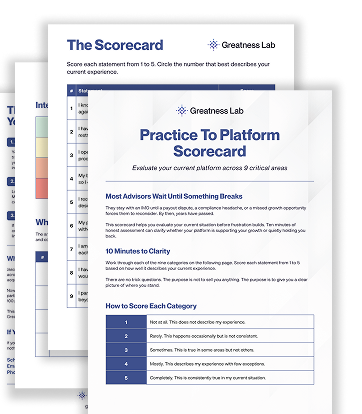
For a quick look at how your current setup compares, you can take Greatness Lab’s Practice Check-Up, a 10-minute self-assessment. You get a scorecard with ratings for your current platform in nine areas. You can then use it to spot gaps that may be costing you income, growth, or exit value.
Why Owners Grow Faster by Bolting On to a Proven System
An owner who has run a business for 15 or 20 years without finding the way to scale can still learn to do it alone. However, an owner who bolts on to a system someone else has already built can get there faster.
Tommy Nickerson, for example, took a chance on Jason at Florida Financial Advisors and built a market there from 0 to 76 team members. He now develops leaders in other markets. If you would like to talk through which kind of partnership fits your business, you can start a conversation with the Greatness Lab team.
Getting Your Business Plan Back on Track for the Rest of the Year
Owners who reset an insurance agency business plan that is behind in the fourth quarter usually work through these steps:
- Charting what worked this year.
- Using the success formula to see whether the gap is will or skill, and finding the part of the business where the year slipped.
- Building the six key activities into your week and checking each day whether you did them.
- Bringing in a partner where the skill or the will is missing.
How much of this year you can still recover depends on how long your cases take to close. Either way, the work you do in the remaining weeks also affects how next year starts.
Plan Your Reset With Greatness Lab Tell us where your year stands and what you want to accomplish in your business next year. We will talk through ways you could work with Greatness Lab to close the gap. |
Questions Owners Ask About an Insurance Agency Business Plan That Is Behind
What should an insurance agency or financial advisor business plan include for the fourth quarter?
Owners who update an insurance agency or financial advisor business plan for the fourth quarter can start with an honest review. They look at which lead sources, follow-up steps, and meetings worked this year. From there, they use the success formula to find whether the gap is activity or conversion. Next, they build the six key activities into a model week with daily targets and a daily check. Where they lack a skill or the will, they can add a partner who has what is missing.
How do I know if my business has a will problem or a skill problem?
You can start by comparing your conversion rate with your activity. If you close a healthy share of the people you see and revenue is still short, activity is the first place to look. In that case, you may not be seeing enough people, which is a question of will. If you are working hard and seeing people, and too few become clients, the gap is conversion, which is a question of skill.
Can I still reach this year's insurance sales goals in the fourth quarter?
Whether you can still reach this year’s insurance sales goals in the fourth quarter depends on how long your cases take from first call to paid business. If your cases close in a few weeks, a year end sales push with more first meetings and presentations can still move this year’s numbers. If they take months, the activity you add now will mostly show up early next year. Either way, the last weeks of a year are a good time to set up the next one.
What are the key activities for insurance agents and financial advisors?
The six key activities for insurance agents and financial advisors are generating a lead, calling that person, seeing that person, case analysis, presenting, and servicing the client. The first three are the most important, and owners who plan this way put all six into a model week with daily targets.
How much time should a business owner spend on recruiting?
For owners who want to grow past their own production, Greatness Lab suggests spending about 20 percent of the calendar on recruiting. Owners spend that time on the people who apply, interview, complete a final interview, and accept a position. A solo producer who chooses not to recruit can still run a good business, and the limit on that business is how many hours the owner can work.
About the Author
Jason Mickool, Founder and CEO of Greatness Lab
Jason Mickool built Florida Financial Advisors from a kitchen table conversation into a national advisor enterprise. It grew to dozens of locations across more than a dozen states, and he completed a nine-figure transaction. Today he brings that operating experience to Greatness Lab, where he coaches insurance and financial business owners who want to build, scale, and exit on their own terms. He is the author of Built to Lead, Built to Scale. Connect with Jason Mickool on LinkedIn or at jasonmickool.com.
Coach Micheal Burt, Founder of The Greatness Factory
Coach Micheal Burt is the founder of The Greatness Factory in Nashville, Tennessee. He is a former championship basketball coach who became a business performance coach. As a best-selling author, he teaches the Prey Drive and Monster mindset frameworks to business owners and advisors. Connect with Coach Micheal Burt on LinkedIn or at coachburt.com.