
You put real work into the recommendation. You built the plan, you walked the client through the numbers, and at the moment you expected a yes, you heard something else. The fees are too high. I need to think about it. Let me talk to my spouse. Something in you tightened, and you did what most insurance and financial advisors do under pressure. You pushed back. You explained harder. You stacked on more information, certain that if the client only understood the value, they would move.
That instinct is the problem. The client did not reject you. The client told you, in the only language available at that moment, that they are not yet certain. An objection is a verbal expression of uncertainty, and the professional who learns to hear it that way closes business the combative seller leaves on the table.
The shift from arguing to diagnosing is learnable, and it changes how you handle sales objections at every stage of the conversation. It rests on the same objection frameworks Greatness Lab teaches insurance and financial advisors inside its Annuity Operating System. What follows is practical. By the end you will know how to read what a client is telling you beneath the words, and how to answer the five objections you hear most.
Key Takeaways
An objection is rarely rejection. It is a request for clarity, certainty, trust, or courage.
- The amateur hears no and gets combative. The professional hears uncertainty and stays curious.
- The stated objection is rarely the real one. Diagnose the cause, not the symptom.
- Two respected schools of selling pull in opposite directions. The strongest producers blend the question-based approach with the conviction approach.
- Five objections account for most lost annuity and policy sales. Each has a framework, not a script.
An Objection Is Rarely Rejection
Think of an objection as an opposing thought. You hold a belief: this client would be better protected, better positioned, better served by moving forward. You share that belief. The client meets it with a thought of their own. That collision is the objection, and it carries far less finality than the seller on the receiving end tends to assume.
The reframe matters because of what the seller does next. The whole question of objection versus rejection turns here: read as rejection, an objection triggers defense; read as uncertainty, the same objection becomes information. Coach Micheal Burt, a former championship basketball coach turned business coach who trains insurance and financial advisors on performance, puts the split plainly: the amateur hears no, I am not interested, while the professional hears I need help making a decision.
The amateur hears a no. The professional hears a request for help making a decision.
When a client objects, they are rarely closing the door. More often they are telling you one of a handful of things:
- A request for clarity. They do not fully understand what you proposed.
- A lack of certainty. They are not sure it will work for them.
- A fear of loss. They weigh what they might give up more heavily than what they might gain.
- A lack of trust. They do not yet trust you with the decision.
- Timing uncertainty. They have too much in motion to treat this as urgent.
- Internal conflict. Part of them wants to move and part of them resists.
- A need for confidence. They do not yet believe they can carry the decision through.
None of those is a rejection. Each is a signal pointing at the work still to be done. Burt names the fix in three words: encourage the client, in the literal sense of giving them courage.
Why Most Producers Handle Objections Backward
The moment a client objects, the seller’s nervous system shifts. Energy moves from curiosity to combativeness, and the conversation turns from a diagnosis into an argument. Coach Burt names four moves that follow, and each one costs the sale.
- They panic and turn combative. The seller feels the no personally, the old wound to handle rejection kicks in, and the response comes out as pressure. This shows up hardest in the hard-charging personality, the producer who likes to create energy and move fast, who reads hesitation as a challenge to overpower.
- They treat symptoms instead of causes. The stated objection is often not the real one. I am busy on the surface. Underneath sits fear of commitment, lack of belief, fear of failure, or lack of trust. Answer the surface and the real objection stays untouched.
- They talk more than they listen. The person asking the questions controls the conversation. The seller who fills the silence with more product detail hands that control away.
- They flood the client with information. Objections are usually emotional, not informational. Meeting an emotional concern with a wall of facts answers a question the client did not ask.
Stay Curious, Not Combative
Curiosity is the discipline that holds all four mistakes at bay. Instead of arguing, the professional asks. Help me understand what feels expensive about this. What piqued your interest the most? Out of everything we covered, what would have to be true for you to feel good about this decision? Each question pulls the client toward their own reasoning instead of pushing them toward yours.
Confused people push. Professionals pull.
The Real Objection Is Rarely the Stated Objection
A client who says the timing is not right may be carrying a quieter resistance: the pure inertia of leaving something that already works. A client who already has something decent will not move for the promise of a little more, because the effort of changing everything feels larger than the upgrade. The objection they say out loud is timing. The objection they are sitting with is the cost of change itself. Name that, and you are finally working on the real thing.
What You Are Hearing When a Client Objects
Clients object for emotional reasons and then justify with logic. The words they choose are a code, and the professional learns to translate it in real time. The table below pairs the four objections you hear most with what the client is usually telling you underneath.
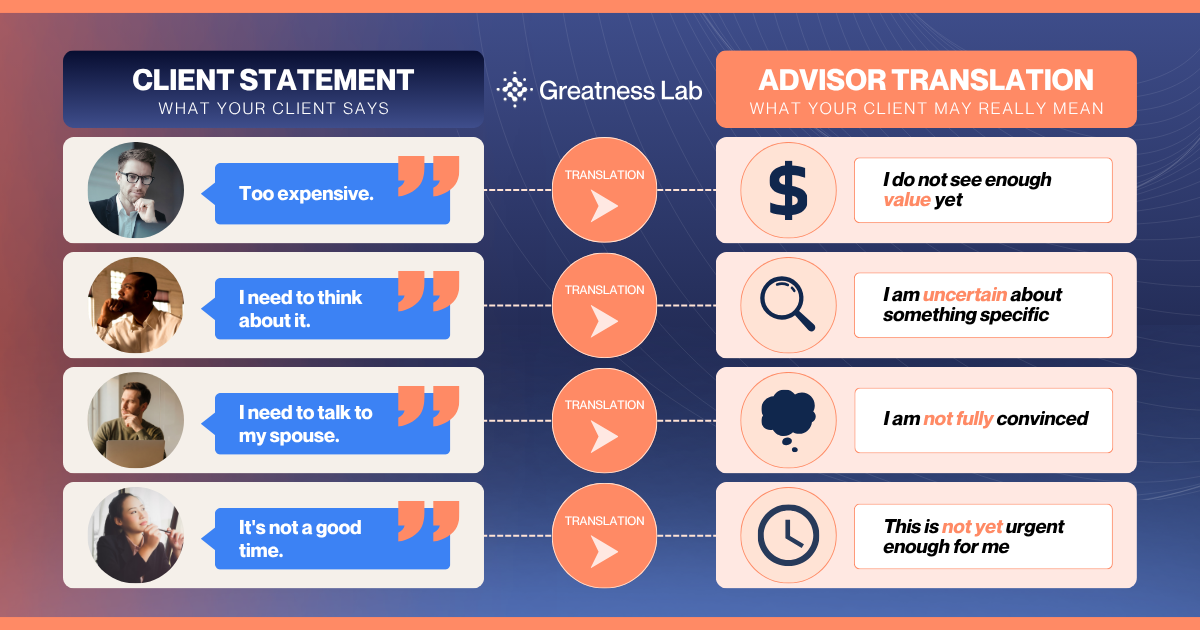
Translation is not a trick. It is the difference between answering the sentence and answering the person. When you hear it is too expensive and respond that I do not see enough value yet, you stop defending your price and start rebuilding the value the client could not see.
Two Schools of Objection Handling, and the Blend That Works
Two of the most respected names in sales training approach objections from opposite ends. Understanding both gives an insurance professional a wider range than either one alone.
- Jeremy Miner built his method, Neuro-Emotional Persuasion Questioning, around lowering resistance. He diffuses pressure, removes tension, and creates safety through tonality and question-based selling. Instead of asking why you would not do this, he asks if you would be opposed to exploring how this could work. The softer construction lowers the client’s defenses. Miner’s premise is that objections appear when enough emotional certainty has not been built, so the work is to make the pain clear, the future vivid, and the trust real.
- Grant Cardone pushes the opposite direction. He treats objections as opportunities to close, and he leans on certainty, conviction, persistence, and urgency. His view is that price is rarely the real barrier, that a client who says too expensive is telling you they do not yet see the value. Where Miner lowers pressure, Cardone raises certainty, on the principle that people borrow confidence from the seller who has it. If the seller’s conviction is weak, the objections multiply.
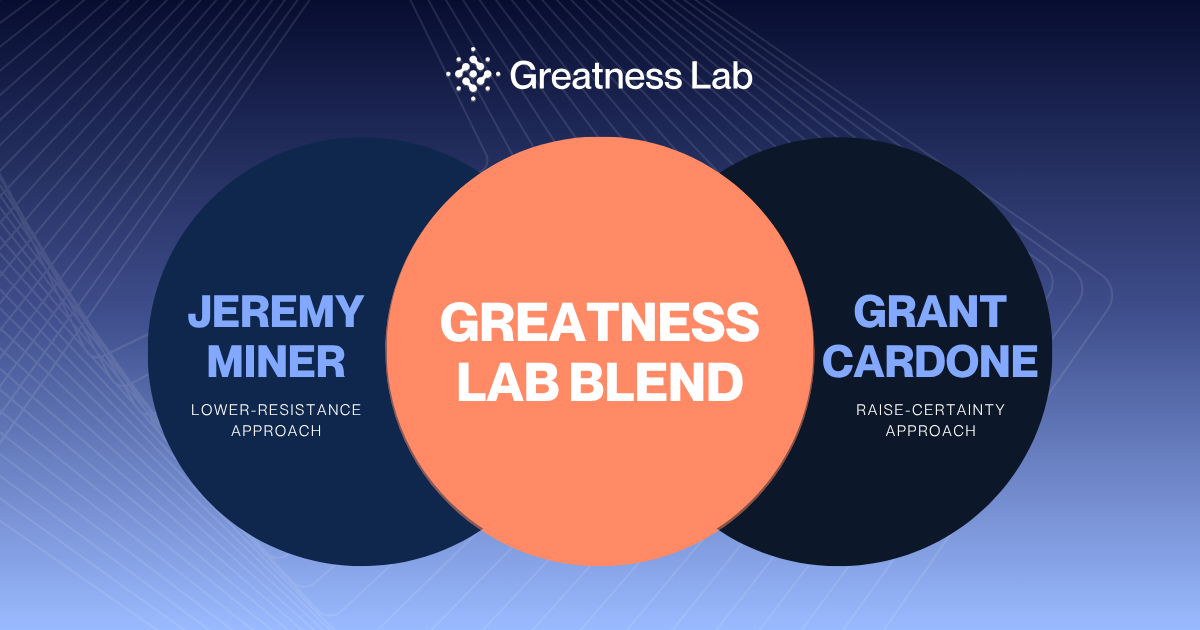
Neither approach wins on its own. Some clients need the question that lowers the wall. Others need the conviction that moves them over the edge once the value is clear. The producer who studies both can read which the moment calls for, and that range is the point. The same instinct sits behind Jill Konrath’s SNAP Selling, which holds that an idea earns a busy client’s attention when it is simple, invaluable, aligned with what they are trying to do, and a priority right now.
Read more on the four SNAP principles on Jill Konrath’s own page for SNAP Selling.
Five Objections Every Insurance and Financial Advisor Hears, and How to Answer Each
Get the frameworks in one page
The Five Objections Every Producer Hears, the three frameworks, and the questions that go with each, on a single reference page you can keep beside the phone. Enter your email to download.
The reframe and the curiosity hold for any sale. What follows is specific to the work you do. Overcoming objections in annuity sales calls for more than a general approach, because these are the five objections that surface most often in an annuity or policy conversation, drawn from the objection frameworks Greatness Lab teaches inside its Annuity Operating System. Each one calls for a framework, not a memorized line, because a framework adapts to the real concern while a script only answers the words.
The Fees Are Too High
Lead with value before you ever defend a number. A fee sounds high only against a benefit the client cannot yet see. Reflect the concern back, then reframe the cost against what it buys: protected income, downside that does not erase years of growth, a plan that holds when the market does not. Compared to what is a fair question to put back gently. Most often the client is comparing your fee to nothing at all, not to the cost of the outcome they are trying to avoid.
I Need Liquidity
Name the fear before you answer the logistics. Behind me I need liquidity is usually a worry about being trapped, about an emergency with no access to funds. Acknowledge that worry as legitimate, then walk through how the structure handles access, so the client is reacting to the real terms instead of the fear of the unknown. The concern is emotional first. Treat it that way, then bring the facts.
I Need to Think About It
This is the stall that hides a specific unresolved concern. Resist the urge to grant the delay and move on. Instead, find what did not land. Out of everything we covered, what felt least clear? Naming what you noticed, gently, surfaces the real objection that the client wrapped inside a polite deferral. The goal is not pressure. The goal is to locate the one thing standing between them and a decision.
My Other Advisor Said Annuities Are Bad
Acknowledge, validate, then proceed. Do not argue with the absent advisor, which only forces the client to defend a relationship and hardens the position. Acknowledge that they have heard that view, validate that plenty of professionals hold strong opinions, then proceed to the specifics of this client’s situation and what this particular structure is designed to do for it. You are not winning a debate about a product category. You are returning the conversation to one person’s plan.
I Do Not Want to Move When Things Feel Uncertain
Sell the Pain, Then Sell the Future
Two things move a person to change, and a complete objection conversation uses both. First, have the client relive the pain, because where there is no pain there is no change. A client at peace with what they have will not move for the promise of more until they feel the cost of staying. Comfort is its own kind of gravity, and until the price of standing still becomes vivid, marginally better will never be reason enough. Surface that cost in their own words.
Then paint the future. Once the pain is present, give the client a vivid picture of what taking action makes possible, and make that pull stronger than the comfort of where they are. Momentum is perishable. Every day a decision sits, some of its energy drains away. The professional does not manufacture urgency out of nothing. They make the real stakes, on both sides, impossible to ignore.
Where there is no pain, there is no change. Where there is no future worth moving toward, there is no reason to.
None of this replaces the deeper work of becoming the kind of professional clients move toward on their own. Objection handling is a skill inside a larger discipline, and it compounds with everything else a serious producer builds. For the broader picture of what changes when an insurance professional commits to that growth, see what real coaching delivers and the habits that draw clients in without chasing them in our piece on becoming an advisor of influence.
Stay Curious, and Let the No Become Information
The producers who close more are not the ones who argue hardest. They are the ones who hear an objection and get curious instead of combative, who translate the words into the concern underneath, and who answer the real thing with a framework built for it. An Objection Is Rarely Rejection. It is a client telling you they are not yet certain, and certainty is something you can build.
That skill is teachable, and it is one piece of a larger discipline Greatness Lab builds with insurance and financial advisors who are serious about scaling. If you want to sharpen how your team handles the conversations that decide your revenue, that is the work.
Build the skill that closes the gap
Greatness Lab is a coaching and growth ecosystem for insurance and financial advisors who want to own more, grow faster, and do it together. Book a strategy call and see how the coaching, the frameworks, and the community fit your firm.
OWN. GROW. TOGETHER.
Objection Handling for Financial Advisors: Common Questions
What Is the Most Common Objection Financial Advisors Hear?
The most common objections financial advisors hear are price, the fees are too high, delay, I need to think about it, and authority, I need to talk to my spouse. Each one usually signals a specific uncertainty instead of a final no, which is why diagnosing the concern beneath the words matters more than rebutting the words themselves.
Is an Objection the Same as a Rejection?
An objection is not a rejection. It is a verbal expression of uncertainty that signals the client needs more information, more certainty, more trust, or more courage before they can decide. Reading it as rejection triggers a defensive response, while reading it as uncertainty turns it into useful information about what the client still needs.
How Should a Financial Advisor Respond to I Need to Think About It?
When a client says I need to think about it, name what you notice before you ask what they need, because the stall almost always hides one specific unresolved concern. A question like, out of everything we covered, what felt least clear, surfaces the real objection the client wrapped inside a polite deferral, so you can address the thing standing between them and a decision.
What Is the Difference Between Jeremy Miner and Grant Cardone on Objections?
Jeremy Miner lowers pressure with question-based selling and emotional safety, while Grant Cardone raises certainty and urgency through conviction and persistence. The strongest producers blend the two, diagnosing with questions first, then transferring certainty once the value is clear, and reading which approach a given client needs in the moment.
Should Insurance and Financial Advisors Use Scripts to Handle Objections?
Insurance and financial advisors are better served learning frameworks than memorizing scripts, because a framework adapts to the real objection while a script only answers the stated one. A memorized rebuttal handles the words a client happened to use, but it cannot follow when the real concern sits underneath those words. A framework such as reflecting the concern back and then reframing it works whether the objection is price, liquidity, or timing, because it starts by diagnosing what the client means rather than reacting to what they said. Scripts earn their place in practice, as a way to internalize language until it sounds natural, but in the conversation itself the producer who is listening will always outperform the one reciting.
About the Author
Jason Mickool, Founder and CEO of Greatness Lab
Jason Mickool built Florida Financial Advisors from a kitchen table into a 750-advisor organization across 27 locations in 18 states, generating over $100 million in annual revenue, culminating in a transaction valued at over $100 million. He applies that direct operating experience inside the Greatness Lab coaching model, working with financial advisors who want to build, scale, and exit their own practices on their own terms. He is the architect of the Annuity Operating System and the Build to Exit framework delivered through the GL platform.
Coach Micheal Burt, Co-Founder of Greatness Lab
Coach Micheal Burt is co-founder of Greatness Lab and founder of The Greatness Factory in Nashville, Tennessee. A former championship basketball coach turned business performance coach, he has worked with tens of thousands of professionals across financial services, healthcare, real estate, and entrepreneurship. He is the author of more than a dozen books including Flip A Switch, Person of Influence, and A to B. His coaching philosophy holds that greatness is manufacturable when people are in the right environment and coached by people who have actually done what they are teaching.