There is a kind of practice owner who has done everything right and still feels stuck. The production is steady. The client base is loyal. The brand is respected. From the outside, this looks like success. From the inside, it looks like a ceiling.
The instinct is to blame the market, the leads, the team, or the comp plan. Sometimes those are real factors. Most of the time they are not the answer. The answer is the environment around the practice owner. Coach Micheal Burt teaches that the right environment activates a kind of relentless pursuit he calls Prey Drive, and that environment does more work than the practice owner’s effort. Five components define an aspirational environment. This article maps them, with a self-check at the end the reader can run on their own firm.
This article is for two practice owners. The first is doing fine, content, and unaware of how much bigger the business could be in a different environment. The second feels the bigger possibility every day, sees peers operating at it, and cannot find the path. Both groups break through the same way: by walking into an environment that asks more of them than they were asking of themselves.
Key Takeaways
- An aspirational environment is the structural difference between practices that scale and practices that plateau. The owner’s effort is not the gap.
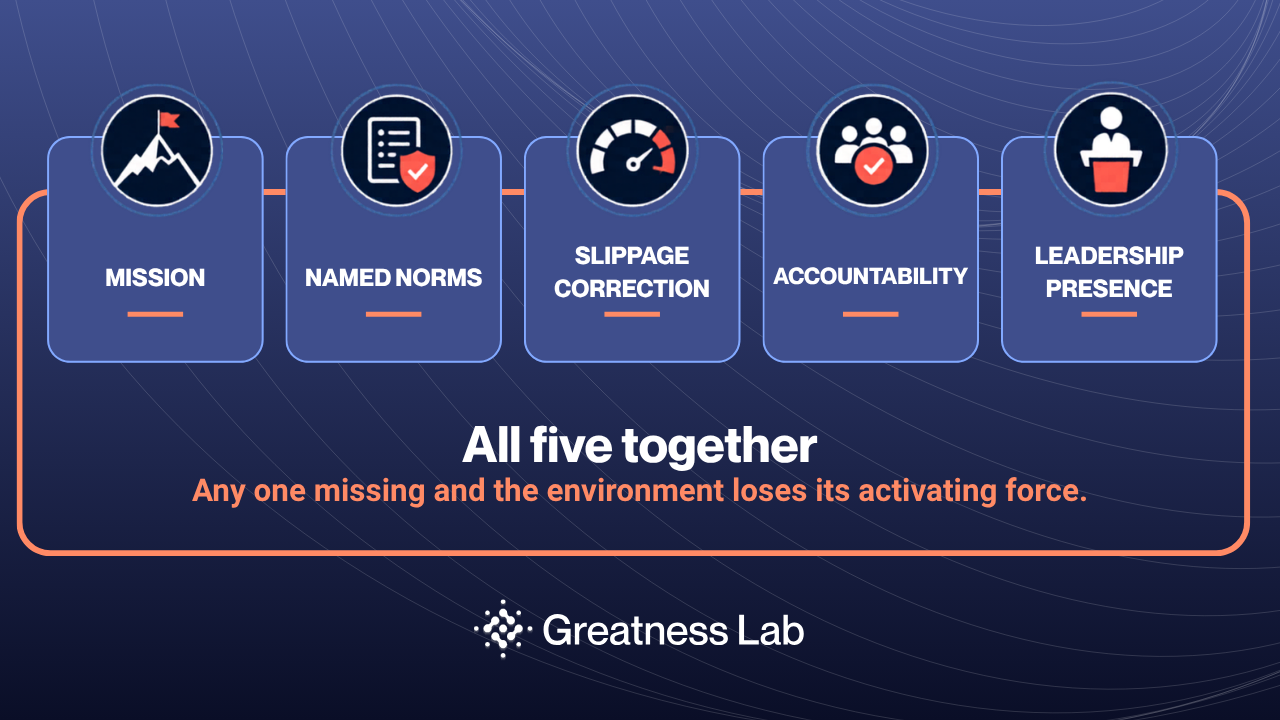
- Five components define an aspirational environment: a clear mission, named norms, slippage correction, accountability, and leadership presence. All five together. Any one missing and the environment loses its activating force.
- Practice owners stuck at a revenue ceiling typically fall into one of two groups: those who do not yet know a bigger version of their business is possible, and those who know it but cannot see the path. The environment serves both groups differently.
- The article closes with a five-part check the reader can run on their current environment to see where it is activating them and where it is leaving them flat.
Why the Environment Decides Outcomes That Effort Cannot
Think about the difference between a college football player who walks on at a top program and a player who walks on at a struggling one. Same talent. Same work ethic. Five years later, one is in the league and the other is selling insurance. The talent gap was not the gap. The environment was.
The same dynamic plays out in advisory practices. Two insurance professionals can finish licensing on the same day, with similar networks and similar hunger, and end up at vastly different places five years later. One ends up running a $5 million enterprise with a team of producers. The other is still grinding for personal production at the same level they started. The difference is rarely talent. The difference is which environment they walked into.
| Fifty percent of your success has to do with you. Fifty percent has to do with the team you played for. |
Tom Brady became the GOAT because he was talented, hungry, and obsessive about preparation. He also became the GOAT because he played in environments that demanded more of him than he would have demanded of himself. Bill Belichick. The Patriots system. The receivers. The film room culture. Without those, Tom Brady is a competent backup quarterback who retires at 32. The environment did half the work.
For practice owners, the environment is the room they walk into every day, the people who are in their calendar, the standards being held around them, and the conversations that happen at the moments where they would otherwise drift. Most practice owners do not have an environment that does this work. They have a job, an office, a set of accounts, an income stream. None of those activate the version of the practice they have not yet built.
Coach Micheal Burt teaches the environment as one of the five activators of Prey Drive in his Wall Street Journal bestseller Flip the Switch, alongside fear, competition, exposure, and embarrassment. Without the right environment, the drive stays dormant. With it, the drive turns on. Coach Burt applies the same logic to advisor practices: the environment around the practice owner is what activates the version of the practice they have not yet built.
One piece of any aspirational environment is who is in the room. Author and career strategist Ken Coleman calls this the proximity principle you become the average of the people you spend the most time around. Proximity to people who have built what you are building reopens the information flow and shows you what is possible. Coach Burt makes the same point in Inside the Mind of a Monster, where he unpacks how the people surrounding a top producer shape the way they think. Proximity is one of five components that define an aspirational environment. The other four are mission, named norms, slippage correction, and leadership presence. All five together is what produces the change.
The Two Buckets of Stuck Practice Owners
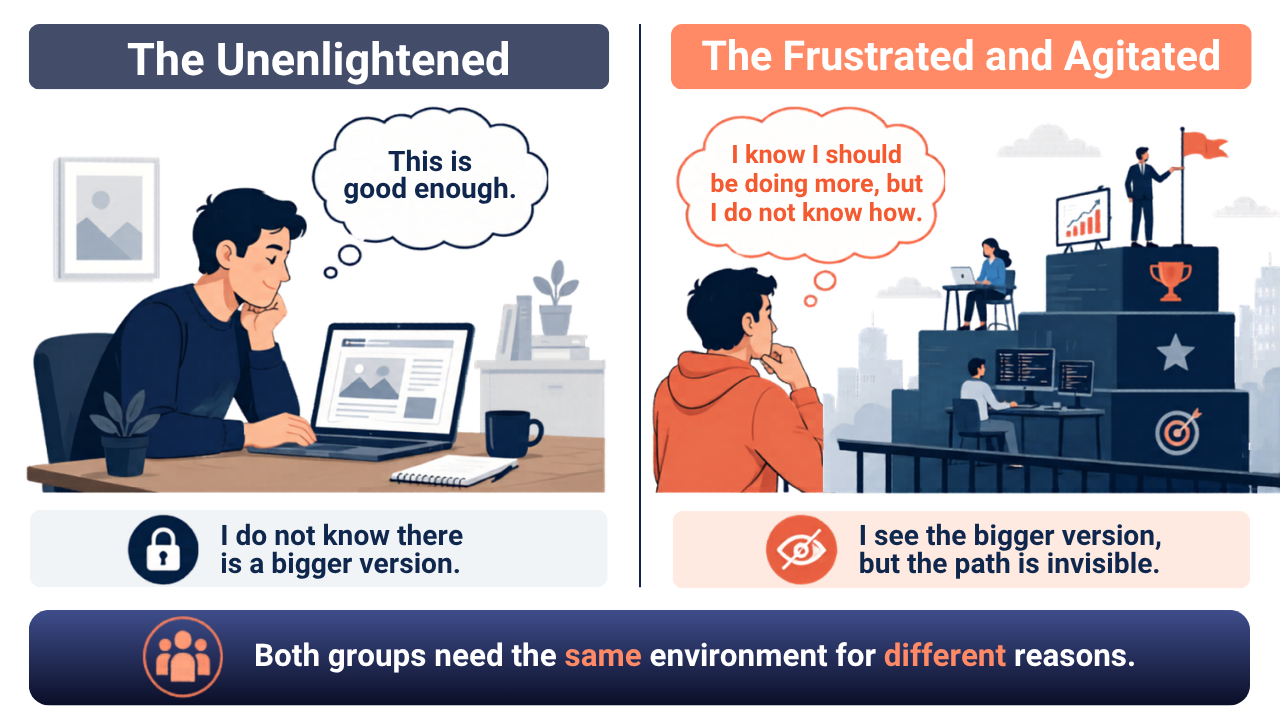
Coach Burt names two distinct groups of practice owners who hit ceilings. The frame is useful because the two groups need different things from an environment, and recognizing which one you are in is the first step toward knowing what you are looking for.
The Unenlightened: Doing Fine, Unaware of What Is Possible
This practice owner has built a respectable business. They are making good money. Six figures, in some cases multiple six figures. They are content. They go to the conferences their existing distribution partners invite them to. They read the same trade publications they have read for ten years. They talk to peers at roughly the same level they are at. And they have no idea that there is a version of their business that produces ten times what they do today, run by people who started where they started.
They have not failed. They have built something respectable, and respectable became the goal. The bigger possibility is invisible to them because they have never been around it. They have not been exposed to anyone whose practice operates at the level theirs could. The environment they live in confirms that what they have is good enough.
The Frustrated and Agitated: Stuck Knowing They Should Be Doing More
This practice owner already knows the bigger version exists. They have seen peers operating at it. They read about it. They feel it in their gut. They tell themselves things like “I know I need to be recruiting people, but I have no idea how to recruit people” or “I know I should be developing a team, but I have never been good at managing.” They are stuck because the inertia of not knowing how is paralyzing them, even though the awareness is already there.
This group needs the environment for a different reason. They do not need to be shown the possibility. They need access to the people who have done it, the systems that make it repeatable, and the accountability that keeps them moving when their own willpower wears out.
Both groups benefit from the same kind of environment. Both groups recognize themselves in the same five components below. The path through is the same.
The Five Components of an Aspirational Environment
Component 1: Mission That Says What the Firm Is For
Most workplaces tell people what to do. Aspirational environments tell people what the firm is for. The difference is small in word count and large in effect. Greatness Lab’s mission is to take people to the highest possible level in their career and life. That sentence does not describe a service. It names an obligation, and the team is expected to align around it.
That kind of mission lands in two different rooms with two different effects. The practice owner who has been running a respectable business without a stated mission usually feels something shift the first time they hear one named out loud. They had been doing the work, taking the income home, telling themselves the business was fine. The mission interrupts that assumption by raising the question of what fine is for. The practice owner who has been frustrated for months feels something different. They have been driving toward something they could not name. A clear mission gives the drive a target and quiets the question that has been spinning in the background.
A mission only works when it is specific enough that a team member can repeat it without prompting and an owner can use it as the test for whether a decision moves the firm toward the identity or away from it. “We help our clients” does no work. “We take people to the highest possible level in their career and life” does. Practice owners who want to go deeper on what this kind of identity shift requires should read the transition from top producer to firm leader, which is the work that has to happen before any operational change holds.
Component 2: Norms the Team Enforces Without You Having To
Norms are the behaviors the environment will not tolerate and the behaviors it expects. Every team has unwritten norms. The difference in an aspirational environment is that the norms are written down, named out loud, and referenced by name when somebody violates one. The naming is what turns a wish into a load-bearing wall.
This is the component where the gap between the two groups is most visible. The practice owner who has been doing fine has run their firm without named norms, often for years, and the team has filled the silence with whatever each person brings from their own history. The practice owner does not see this as a problem because the team is producing and the conflicts have been quiet. The frustrated practice owner has been watching their own firm erode in slow motion. Late arrivals nobody calls out. Side conversations they can hear from across the room. The chronic complainer who has been allowed to set the temperature for everyone else. They know exactly what is wrong. They have not had the language for the fix.
Jason Mickool runs five named norms across his businesses. Each one solves for a specific behavior pattern that would otherwise erode the culture. Read them slowly. The first time most practice owners read this list, they recognize at least two behaviors in their own firm that have been costing them for months.
- Lombardi Time. If you are 10 minutes early, you are on time. If you are on time, you are late. The norm exists because tardiness creates a downstream cost the team gets tired of absorbing. Saying “we do Lombardi Time here” is faster than a lecture, and it works coming from a peer.
- Everything is always excellent. Borrowed from Saving Private Ryan. When something is wrong, you take it up to leadership. Complaining laterally erodes morale and solves nothing. The norm makes that distinction explicit.
- State what you are for. If you are going to raise an issue, name the solution you are advocating for. The norm forces people from problem-naming into problem-solving and weeds out chronic complainers who never have a position.
- Define your outcome. Before any difficult conversation, ask three questions: what do I have to gain, do I want to be effective or right, and what is the outcome I want? The norm keeps conflicts from spiraling into ego battles that nobody wins.
- No bad hires. Once a person is hired, it is the manager’s responsibility to make them successful. The norm reframes hiring failures as leadership failures, which forces managers to take ownership of every person they brought in.
| Norms are what bother you about people, written down so the team can hold each other to them instead of you having to. |
Component 3: Closing the Gap Between Trained and Executed
Coach Burt has a name for the gap between what someone was trained to do and what they do in the game. He calls it slippage, and every team has it. Most practice owners have been losing money to it for years without realizing the leak has a name.
In sports, the coach trains the play in practice. The team runs the play perfectly when the coach is calling cadence. Then the game starts and the play looks different. The athletes drift. They improvise where they were not supposed to. The practice was right, the execution slipped. Coaches close the gap with film, with corrections, with running the same drill until the slippage stops.
Practices are no different. The producer is trained on a sales process and drifts the moment a real client pushes back. The team is trained on a follow-up cadence that collapses the moment someone gets busy. The owner is trained on how to delegate and takes everything back the first time something goes sideways. Slippage is invisible to the practice owner who has never measured it, and visible to the practice owner who has been bleeding from it for months without knowing the word.
The two groups face different first moves. The practice owner who has been doing fine has not been measuring slippage because the revenue has not screamed at them yet. They need to start watching their team in real conditions, not in training. The practice owner who has been frustrated has been watching the slippage all along and has been blaming the people. They need to stop blaming the people and start fixing the system. Same gap. Same fix. Different starting awareness. The two mechanisms below close the gap for both groups:
- Inspect what you expect. Every leader at every layer is expected to verify execution along with assigning it. When a producer says “I tried that and it did not work,” the leader’s response is “show me you’re doing it.” Most of the time, what the producer was doing was different from what they were trained to do. The producer believed they were running the script. The film of the meeting tells a different story.
- Do nothing alone. Coaching opportunities are turned into observation opportunities. A producer running a Zoom meeting with a client is not just running the meeting. Three or four other team members are watching, with cameras off, taking notes, ready to debrief afterward. The producer gets real-time experience. The observers see what working through a real call looks like. Nobody develops in isolation, which means nobody slips in isolation either.
Slippage correction is what separates a culture that retains its team from one that just pays well. The team stays because they can see themselves getting better, not because the bonuses are good. Practice owners who get this right close a gap most of their competitors did not know they were losing.
Component 4: Accountability That Holds When Standards Drop
Where there is no consequence, there is no change of behavior. Accountability is the layer that makes everything above it enforceable. Without it, the named norms are wishes, the mission is decoration, and the slippage correction is an inconvenience the team waits out.
Accountability is rarely about punishment. The strongest accountability is positive: recognition, advancement, ownership stakes, peer respect that gets earned and lost based on how someone shows up. The negative side matters too, and the strongest environments are not afraid of it. Hard conversations when standards drop. Written plans when behaviors do not change. Exit when the gap between what someone says and what they do becomes structural.
This is the component most practice owners say they have and most practice owners do not have. The practice owner who has been doing fine assumes the team is being held to standards because the team has not blown anything up. The truth is that the team has been operating at the bar the lowest performer is willing to deliver, and the practice owner has been compensating for the gap by working harder themselves. The frustrated practice owner has been telling themselves they need to have the hard conversations and has been postponing them because the cost feels higher than the gap. Both groups are hire-for-accountability-but-back-away-from-enforcing-it owners. The team learns within ninety days whether the standards are real or aspirational.
| If the standards are real, the team self-selects. If the standards are aspirational, the team does the math and the bar drops to whatever the lowest performer is willing to deliver. |
Component 5: Leadership AI Cannot Replace
The fifth component is the human at the front of the environment, doing the work no system can do. Noticing what is going wrong before the metrics catch it. Calling people up to a higher version of themselves. Telling them the truth when they are coasting. Inspiring them to keep going when the work gets hard. AI cannot do any of this. The pitch decks for AI hiring tools and AI coaching tools sell the dream that it can. The practice owners who buy the dream find out within a year that they bought a calendar tool with a chatbot, when what they needed was a leader.
Take a great leader and put them in a struggling firm. Same producers, same comp plan, same tech stack. Six months later the firm is competing for the top of the market. Take a weak leader and put them in a thriving firm. Six months later the team was scattered. The leadership variable does more work than any other input, which means leadership development is the variable practice owners should hire most carefully for and the variable they should evaluate without flattering themselves.
| Leadership always drives success. AI is not going to fix that. People work for people, not robots. |
Both groups face the same question at this component, but they face it from opposite directions. The practice owner who has been doing fine has to decide whether they are willing to be the leader the firm needs in order to scale, which means becoming someone they have not been. The practice owner who has been frustrated has been trying to be that leader and has been finding it lonely. They need an environment with other leaders in it, leaders who have done what they are trying to do and who will tell them the truth when they ask. Whichever group you are in, the question is the same: who is doing the human work in your current environment? If the answer is nobody, the environment is not activating anyone, no matter how strong the other four components are.
Five Questions to Run Against Your Current Environment
Run these five questions against the environment you are operating in right now. Answer them as the practice owner you are today. Set aside the one you imagine yourself becoming. The questions are simple. Honesty is the hard part.
Component | Ask Yourself |
|---|---|
Mission | Does the environment I am in tell me what the firm is for, or just what I am supposed to do? |
Named norms | Can I name three behaviors my team is held to that we have all agreed are required? |
Slippage correction | When someone on my team drifts from what they were trained to do, is there a system that catches it, or do I find out three months later? |
Accountability | When standards get violated, does something happen? Or do I let it go because the conversation feels harder than the cost? |
Leadership presence | Is there someone in my environment, including me, doing the human work of calling people up? Or is everyone heads-down on their own work? |
How you read your own answers depends on which group you started in. The practice owner who has been doing fine and answers yes to most of these is in a quiet ceiling. The environment is not pulling them backward, but it is not pulling them forward either. They are stable, which is the most dangerous place to be when the work could be ten times bigger. The practice owner who has been frustrated and answers no to two or more of these has just located the problem they have been carrying. The frustration was not random. It was the gap between what the environment was supposed to be doing and what it has been doing. Either way, the next question is whether the missing components can be built inside the current setup or whether the practice owner needs to walk into one that already has them.
Build the Environment or Join One
Practice owners who recognize the gap have two paths. Both groups face the same two paths from different starting points, which is worth naming before walking through them.
The first path is to build the environment yourself, inside your current practice. Hire the leader who makes this happen, write the norms, install the slippage correction, build the accountability layer, and fund the whole thing on your own production. This works. It takes years. It also requires you to have already seen what an aspirational environment looks like from the inside, because you cannot build what you have not experienced. The practice owner who has been doing fine and has never been inside one will struggle to invent the components from scratch. The practice owner who has been frustrated has at least seen versions of the components in other firms and has a clearer picture of what is missing.
The second path is to join an environment that already has the components in place and use that environment to grow your practice faster than you could grow it alone. This is what the strongest practice owners did when they were earlier in their careers. They got around people who had built what they were trying to build, plugged into the systems those people had developed, and let the environment compound their effort. For the practice owner who has been doing fine, this path is the fastest way to discover what an aspirational environment is, by walking into one. For the practice owner who has been frustrated, this path is the fastest way to stop spinning, by being surrounded by people who already know how.
The Greatness Lab is the second path. Coaching at the center, operational infrastructure that scales practices, and a community of insurance and financial advisors building serious enterprises. The aspirational environment Coach Burt and Jason Mickool spend their time inside is the one they invite practice owners into when they sense the practice owner is ready to stop coasting. If the questions above pointed at gaps in your current environment, a conversation about whether the Greatness Lab fits is the next step. To go deeper on what advisors receive when they join, read more about how the Greatness Lab Membership is structured.
Common Questions About Aspirational Environments and Practice Growth
What is the difference between company culture and an aspirational environment?
Culture is the set of behaviors and beliefs already inside an organization. Every firm has one. An aspirational environment is a deliberately built culture that asks more of the people inside it than they would ask of themselves. Culture describes the present. An aspirational environment pulls people toward a future. The five components named above are how an aspirational environment is built, regardless of what the existing culture looks like when the work starts.
Why am I stuck at the same revenue year after year?
Why do most insurance and financial advisors plateau at a certain revenue level?
Can a small practice with three or four people have an aspirational environment?
Yes. The five components scale down. A practice owner with three team members can name a clear mission, write down the norms, build slippage correction into weekly meetings, hold accountability when standards drop, and bring real leadership presence to every interaction. The clarity of the components determines whether the environment is activating, more than the size of the team does. Some of the strongest aspirational environments operate with under ten people. Some of the largest firms in the industry run cultures that are inert.
How long does it take for a new environment to start activating someone?
The shift is usually visible within ninety days. The practice owner who walks into an aspirational environment starts asking different questions, looking at their business with different criteria, and noticing gaps in their own operation they had stopped noticing. Behavioral change follows mindset change, usually within six months. Revenue impact lands within twelve to eighteen months because compounded behavior change takes time to convert into compounded results.
What if I am the leader and my team is not responding to the standards I am setting?
The Environment Is the Decision
The environment around a practice owner does more work than their effort. Practice owners hit ceilings their willpower cannot break because the environment they are inside is producing exactly what it is structured to produce. The ones who break through almost never do it alone. They walk into an environment that demands more of them than they were demanding of themselves, and the environment does half the work from there.
The five components are the test. Mission, named norms, slippage correction, accountability, leadership presence. Run the questions from the self-check section against your current environment without flattering yourself. If it has all five, the work is to keep showing up. If it has three or four, the question is whether the missing pieces can be built. If it has fewer than three, the practice owner has a decision to make about which environment they want to spend the next decade of their career inside.
The Greatness Lab was built around these five components for insurance and financial advisors who want to scale beyond what they can produce alone. Whether you are the practice owner who has been doing fine and is now wondering how big the business could be, or the one who has been frustrated and is ready for a path, a conversation is the next step.