
Ask ten financial advisors what they do, and nine will answer with a title and a list. “I do comprehensive financial planning and wealth management.” The words are accurate. They are also forgettable, and forgettable is expensive, because the right client cannot tell you apart from the advisor they met last week who said the same sentence.
The problem is not that you lack value. The problem is the order in which you explain it. Most advisors lead with what they do. The advisors who win the right clients lead with what they believe, and let the rest follow. That reordering is the whole game, and it has a name.
Coach Micheal Burt, a longtime business coach and chief distribution officer of the Greatness Lab, teaches a six-step framework he calls the Explanation of Value. As part of Greatness Lab’s financial advisor business coaching, it is a structured way to articulate your financial value proposition so the right people recognize you and the wrong ones move on. In a recent Greatness Lab session, he walked through it live with Jason Mickool, who built a national advisor enterprise across more than a dozen states. What follows is that framework, and how to build your own.
Key Takeaways
- Most advisor value propositions fail because they lead with services instead of belief, so everyone sounds the same.
- People do business with those who believe what they believe, so a strong, even polarizing belief attracts the right clients.
- The Explanation of Value is a six-step framework: belief, why, what you recommend, how you differ, who it is for, and the call to action.
- A message that repels the wrong people is doing its job. One that offends no one rarely attracts anyone.
- The same framework works for recruiting, advisor team building, hiring, and partnering, because misaligned belief is the root of most conflict.
Why Most Financial Advisor Value Propositions Sound the Same
Walk into a room of advisors and the language blurs together. Comprehensive planning. Holistic wealth management. A personalized approach. Each phrase is true, and each one describes ten thousand other practices. When everyone says the same thing, the prospect has no way to choose except on price or proximity, and neither of those is a fight you want. This is one of the reasons financial advisor business coaching often begins with clarifying an advisor’s message before focusing on business growth.
Burt traces the sameness to a single habit: advisors explain what they do for a living by describing the product or the service. That instinct turns a distinctive professional into a generalist. The fix is not louder marketing or a cleverer tagline. It is a different starting point.
Why people do business with those who believe what they believe
Here is the principle the whole framework rests on. People do business with other people who believe the same things they do. When you open with a belief, you give the listener something to agree with, and the right person nods before you have described a single service. Burt watched it happen in the session: as Jason named his core beliefs, Burt found himself nodding, which is exactly what happens when the other person already believes what you believe.
Think about how you vote. You rarely know the candidate personally. You are casting a ballot on whether their stated beliefs line up with yours, and you accept that you will not agree on everything as long as the core is aligned. Clients choose advisors the same way. Belief first, details later. It’s a principle reinforced through advisor leadership training because trust is built around shared beliefs before expertise is evaluated.
The Explanation of Value: A Six-Step Framework
Burt credits the seed of the idea to one of the top whole-life producers he coached, who wanted to stop selling insurance and start selling a strategy, and built a three-part “explanation of service.” Burt expanded it into a six-step way to explain value. By his own account, that is where the framework comes from.
The six steps run in order:
- Lead with what you believe.
- Explain why you believe it.
- State what you recommend.
- Show how you do it differently.
- Name who you do it for.
- Make the call to action.
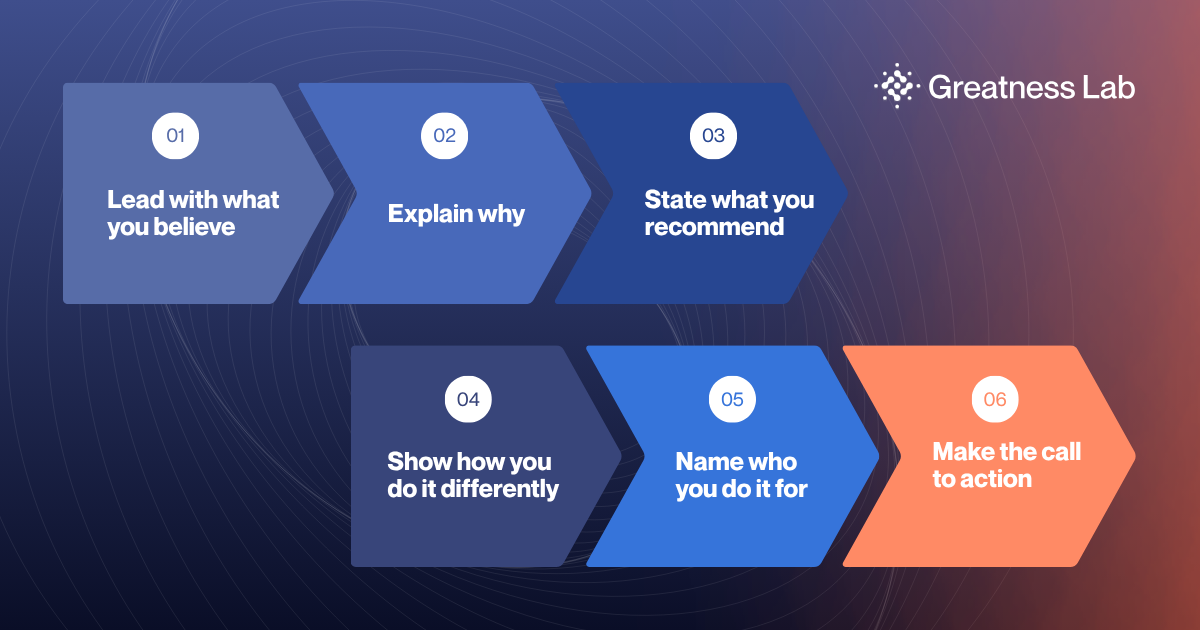
Get clear on these six and something useful happens to your own confidence first. You stop fumbling the “what do you do” question and start answering it the same way every time, whether you are on a stage, on a podcast, or across a kitchen table. Burt runs every interview answer through this filter. It’s the same kind of clarity that effective business coaching helps financial advisors develop before they ever refine their marketing or sales conversations. The value to other people comes second; the clarity it gives you comes first.
Step 1. Lead With What You Believe
Open with a conviction, not a credential. When Jason explains the Greatness Lab, he does not start with programs or pricing. He starts with a belief: everyone needs a coach, and the accidental arrogance of success is what convinces people they have arrived and can stop learning. State a belief with that kind of conviction and the right listener leans in. The wrong one checks out, which is the point.
Why a message that repels the wrong people attracts the right ones
Soft beliefs attract no one. Burt puts the bar bluntly: you need a message that, if it does not repel some people, will not attract the right people. The stronger and more polarizing the belief, the faster the right clients align with you, because alignment is the thing you are selling. Developing that conviction is part of strong leadership development for financial advisors, where the goal is to lead with clarity instead of trying to appeal to everyone. On social media, where a viewer decides on the length of a short video, a clear belief is what earns the yes. A hedged one earns a scroll.
A message that offends no one rarely attracts anyone. The repelling is the sorting.

Step 2. Explain Why You Believe It
A belief lands harder when the listener knows where it came from. Jason believes coaching changes outcomes because he lived it, building in nine years what most advisors never approach, alongside his wife. That is not a credential he recites. It is a reason that makes the belief credible.
The story of origin
Burt calls this the story of origin: the exact moment a conviction was formed. His own goes back to a single mother who left him at a baseball field at four and five years old, where coaches believed in him while she worked. That is why he holds, at the core, that everyone needs a great coach. The story is not about decoration. It is the evidence that your belief is earned, not borrowed, and earned belief is the kind people trust.
Step 3. State What You Recommend
Now, and only now, you say what you do. The sequence matters. Because the listener already knows what you believe and why, your recommendation arrives as the natural conclusion of a conviction instead of a pitch dropped on a stranger.
Think like a doctor
A good physician does not open with a prescription. She examines, explains what she believes is going on, and then tells you what she recommends, and you follow it because the reasoning came first. Do the same. Based on what I believe, and here is why I believe it, this is what I recommend you do. The structure earns the recommendation the authority a bare pitch never gets.
Step 4. Show How You Do It Differently
This is the step that answers the question every prospect is silently asking: what makes you different from the last advisor I talked to? Jason draws the line between a coach and a practitioner. Plenty of people will tell you what to do to succeed. Fewer can say they have built, grown, and scaled the thing they are coaching you toward. He has done it, so his guidance carries the weight of having been there, none of the lightness of theory. That’s the difference between generic advice and practice management coaching rooted in real experience.
Your differentiator does not have to be a nine-figure outcome. It has to be specific and true, and it has to be something the advisor across the street cannot truthfully claim. Vague differentiation is no differentiation. Name the thing only you can say.
Step 5. Name Who You Do It For
Tell the listener exactly who you serve, and do it by naming a real person instead of a category. “Insurance and financial professionals who want to build, grow, and exit on their own terms” is sharper than “clients.” When you name who it is for, the right listener recognizes themselves and the wrong one excuses themselves, and both outcomes save everyone time. That kind of positioning gives advisors a stronger foundation for long-term practice growth because it attracts clients who already align with their beliefs.
Proof of concept
Naming who you serve gets stronger when you can point to someone you have already served. Proof of concept is the client who looked like the person you are describing and got the outcome you are promising. One concrete example does more than a page of adjectives, because it moves your claim from aspiration to track record.
Step 6. Make the Call to Action
End by telling the listener what to do next. Amateurs skip this step, and skipping it is why good conversations die in the parking lot. Burt draws a hard line between conversations and conversions. A conversation feels good and changes nothing. A conversion gives the person a specific next step while the belief is still fresh. It’s an approach you’ll often see in structured coaching programs for financial advisors, where every conversation is designed to move toward meaningful action.
The call to action does not need pressure. It needs clarity. If this sounds like something that fits you, here is the next step. Said plainly, after the listener already believes what you believe, it lands as an invitation, not a push. That combination of clarity and consistency is one reason Greatness Lab’s financial advisor business coaching helps advisors communicate their value more effectively. For why the next step has to be locked before the energy fades, see the companion piece on the psychology of decision making in sales.
Is the Explanation of Value an Elevator Pitch?
Search “financial advisor elevator pitch” and you will find a thousand variations of the same advice: be brief, be clever, stop the listener in thirty seconds. Most of that advice quietly contradicts itself, because the experts who write it keep telling advisors to ditch the pitch. They are right, and so is Burt, who states it flatly: this is not an elevator pitch.
An elevator pitch tries to impress a stranger in a few seconds. A belief-led value proposition does something different. It articulates a belief that lets the right person recognize alignment with you, so the goal is not to dazzle but to sort. One is a performance. The other is a filter that brings the right clients closer and lets the wrong ones go, creating the foundation for sustainable business growth instead of one-off conversations. which is a far more useful outcome than applause.
The Framework Works Beyond the Sale
This framework is not only for selling. Burt makes a larger claim that holds up: most conflict happens when two people do not believe the same things. Two strong beliefs out of alignment will eventually grind against each other, whether the relationship is a sale, a hire, or a partnership.
That makes the same six steps useful far past the close. After the session, Jason said he would take the framework back to his executives and apply it to recruiting: what do we believe, why, what do we do differently, and what is the call to action for someone deciding whether to join. Run a candidate through it and you find belief misalignment before it becomes a bad hire. The advisors who learn to recruit and train at scale use this same clarity to attract people who already believe what the firm believes, creating a stronger foundation for financial advisor recruiting and long-term advisor team building which is the only kind of hire that lasts.
There is an inward use too. Burt closes on a quieter point: your actions follow your beliefs, so a belief that you could never scale or never exit will shape every move you make. The advisors who break through often have to change a belief about themselves first, the kind of limiting beliefs that quietly cap a practice long before the market does. It’s this mindset shift that often helps advisors transform a practice into a business capable of long-term growth.
Amateurs Dabble. Build Yours Until It Is World-Class
Frequently Asked Questions
What is a financial advisor value proposition?
A financial advisor value proposition is a clear articulation of the value you deliver and what makes you different, stated so the right clients recognize you are the advisor for them. A strong one leads with belief rather than a list of services, which is what separates it from the generic statements most advisors use.
What is the Explanation of Value framework?
The Explanation of Value is a six-step framework for articulating your value: lead with what you believe, explain why you believe it, state what you recommend, show how you do it differently, name who you do it for, and make a call to action. Coach Micheal Burt teaches it as part of business coaching for financial advisors, helping them stop sounding like commodities and start attracting clients who share their beliefs.
Is a value proposition the same as an elevator pitch?
A value proposition is not the same as a traditional elevator pitch. An elevator pitch tries to impress a stranger in seconds, while a belief-led value proposition articulates a conviction that lets the right person recognize alignment with you. The goal is to sort for fit, not to perform.
How do you explain what you do as a financial advisor?
You explain what you do as a financial advisor by starting with what you believe about money, advice, or outcomes, then connecting that belief to what you recommend and who you serve. Leading with belief rather than services helps the right clients see themselves in your message before you describe a single product.
What makes one financial advisor different from another?
A financial advisor stands apart by articulating a specific, true belief and approach that competitors do not claim, which lets the right clients self-select instead of comparing advisors on fees alone. Vague differentiation reads as no differentiation, so the distinguishing claim has to be something only you can truthfully make.
Build a Value Proposition Worth Remembering
The advisors who get remembered are not the ones with the slickest tagline. They are the ones who can say what they believe, why they believe it, what they recommend, how they are different, and who it is for, and then name the next step. That is the Explanation of Value, and it is a skill you build, not a line you memorize. Do the work once and every introduction, every recruiting conversation, every partnership gets clearer.
Build yours with people who do this every day. The Greatness Lab coaches insurance and financial advisors through frameworks like the Explanation of Value, with the structure and the room of operators that turn a concept into a skill you use every day. Become a member and build a value proposition the right clients remember. |
Not ready to join yet? Book a strategy call to see how Greatness Lab’s insurance advisor growth services can help you refine your message, strengthen your positioning, and build a business that attracts the right clients.
About the Author
Jason Mickool, Founder and CEO of Greatness Lab
Jason Mickool is the founder and chief executive of a national advisor enterprise built from scratch and scaled across more than a dozen states. He is a best-selling author and the founder of the Greatness Lab, where his core belief is that everyone needs a coach.
Coach Micheal Burt, Co-Founder of Greatness Lab
Coach Micheal Burt is a business coach and the chief distribution officer of the Greatness Lab. A best-selling author with decades of coaching experience, he developed the Explanation of Value framework and teaches operators and advisors to articulate what makes them different.