Most financial advisors who reach a plateau are not stuck because they lack skill. The skill is there. The work is there. The clients they have are well served. And yet the practice has stopped attracting new clients the way it used to. The advisors who attract clients consistently are the ones who built something the rest of the field has not.
The problem sits somewhere else. The market does not know who you are. The people who would buy from you cannot find you. The deal flow that should be coming to you is going to advisors who are no better at the work, but who are easier to find, easier to remember, and easier to invite into something. This is the gap between being skilled and being chosen.
Coach Micheal Burt has spent two decades teaching what closes that gap. In his book Person of Interest and in the coaching practice he runs out of The Greatness Factory in Nashville, the frame is direct. There is an imaginary line between the practice owners the market knows and the practice owners the market does not know. Skilled advisors who never cross that line stay obscure forever. The crossing is not random. It is a five-ingredient build, paired with a four-discipline operating sequence, that any practice owner can install.
This article walks through both. The five ingredients name what an advisor of influence has that you have not yet built. The four disciplines, find, package, market, and monetize, name how you cross the line and turn reputational capital into the ability to attract clients on rhythm. Practices that attract clients consistently install all four. The takeaways below summarize what changes when the framework goes into place.
KEY TAKEAWAYS
- Skilled financial advisors stop attracting new clients when they sit on the unknown side of the visibility line, not when their work declines.
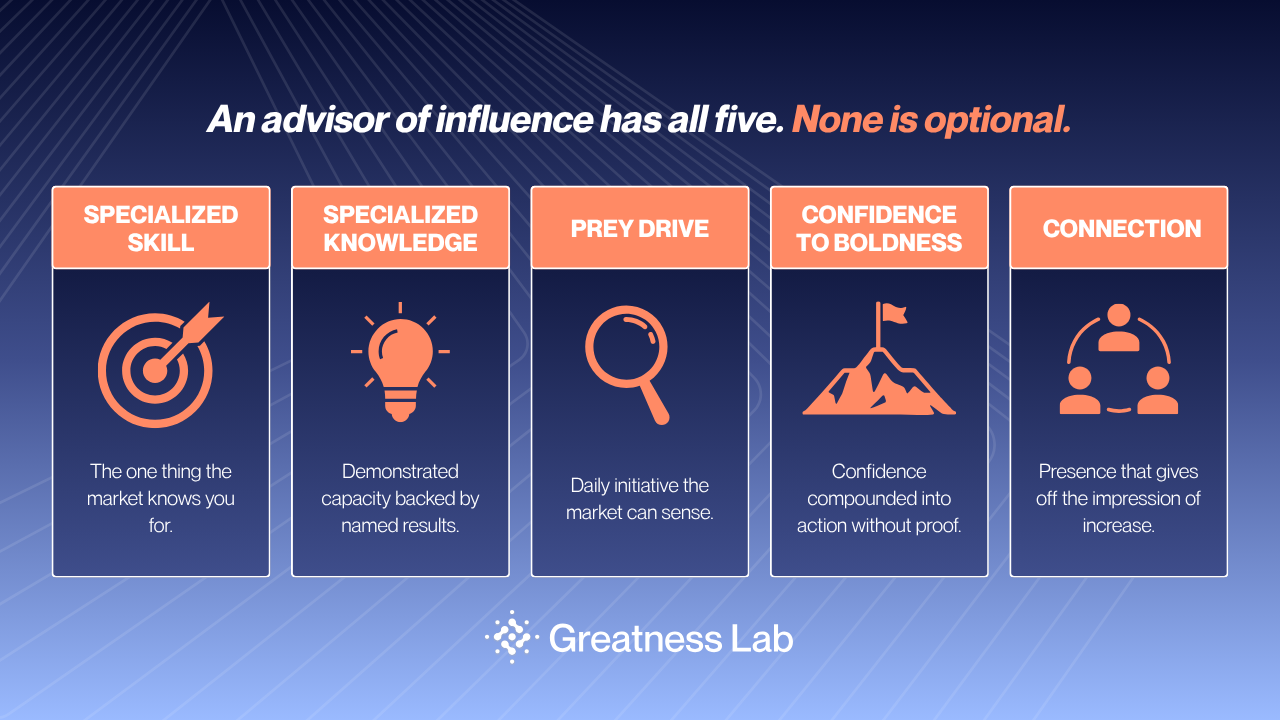
- An advisor of influence has five ingredients in place: specialized skill, specialized knowledge with demonstrated capacity, prey drive, confidence that converts to boldness, and connection that gives off the impression of increase.
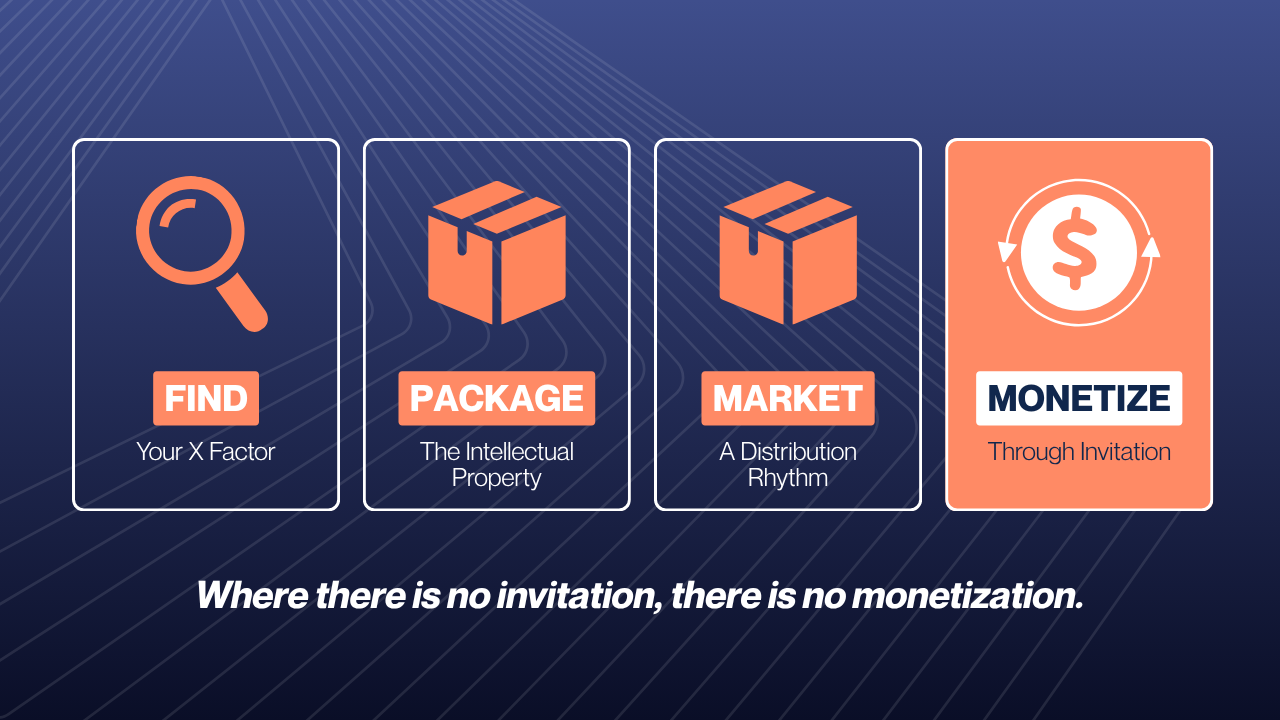
- The four operating disciplines that cross the line are find, package, market, and monetize. Where there is no invitation, there is no monetization.
- The objective is not return on investment. The objective is to become known. Practice owners who reframe their week around that objective change what they spend their time on, and the deal flow follows
Why Skilled Financial Advisors Stop Attracting New Clients
If you are producing somewhere between five hundred thousand and two million dollars and you have been at it for five or more years, the pattern is probably familiar. You did the work to build the skill. You learned the products, the planning, the conversations. You serve your clients well and most of them tell you so.
And yet the practice has stopped pulling new business toward it the way it used to. Referrals are slower. Inbound calls are rarer. The practice has stopped attracting clients on its own. The advisors you respect seem to be growing without working harder, and you cannot fully see what they are doing differently.
The instinct is to blame the market, then the platform, then the comp, then your own effort. None of those is the real cause. The cause is structural. You are still on the unknown side of a visibility line that the market draws around every practice owner, and the work you have been doing does not cross it.
The advisors who attract clients consistently are not better operators than you. They are advisors who installed something you have not yet installed. That installation is the difference between chasing the market and being chased by it.
A practice owner Coach Burt was talking with recently described his vision as a boutique financial advisory business for ultra high net worth clients. The vision was respectable. The math did not work. As Jason Mickool put it in the session that produced this article, boutique would insinuate smallness, and people are not naturally drawn to operators who define themselves by smallness.
They are drawn to operators with big visions and the boldness to move on them. The language a practice owner uses about the size of the practice quietly sets the ceiling on what the practice can attract. The first move out of the plateau is to notice what you have been telling yourself about the size of the work you are willing to do.
Most plateaued practices do not have a talent problem. They have a distribution problem. The clients exist. The skill exists. The connection between the two has never been built. Closing that gap, and learning to attract clients without chasing them, is what the rest of this article is about.
What an Advisor of Influence Has That You Have Not Yet Built
Coach Burt began codifying the qualities of people who attract opportunity more than two decades ago, after sitting in a coaching room watching a man across the table command the attention of every advisor in it. He started writing down what the man had that the rest of the room wanted. The list became the spine of his book Person of Interest, and the same list maps cleanly onto the financial advisor and insurance professional who wants to stop chasing the market.
There are five ingredients. Each one is a thing the reader can build, not a thing the reader was born with.
Specialized Skill
The first ingredient is a specialized skill that the market recognizes as scarce. The frame is a heart surgeon, not a general practitioner. A practice owner who tries to sell every product to every prospect is building a practice on volume, not influence. A practice owner who can articulate the one thing they are exceptional at is building a practice the market knows what to call.
Specialized does not mean narrow product. A specialist in connection, a specialist in value articulation, a specialist in lowering walls of resistance, a specialist in recruiting and developing producers, all qualify. What the ingredient requires is that you can finish the sentence: I am the practice owner clients come to when they need a specific outcome. If you cannot finish the sentence, the market cannot finish it for you, and the market needs to be able to finish it before it can refer.
Specialized Knowledge and Demonstrated Capacity
The second ingredient is specialized knowledge backed by something the practice owner has done, not just something they have learned. Knowledge without demonstrated capacity is a credential. Demonstrated capacity is what attracts clients.
Jason Mickool and Coach Burt run a program inside Greatness Lab called the Annuity Operating System, the AOS. The AOS is the named system that produced six hundred million dollars in annuity production through the firm Jason built, alongside eleven thousand financial plans. The number is the demonstrated capacity. The name is the package. Without both, the work is invisible. With both, advisors fly across the country to spend two days inside a workshop on it.
The reader has probably already done something that qualifies. The discipline is to give it a name, claim the rights to the name, and put the name in front of the people who would pay for the result.
A practice owner who has reduced taxes for a thousand small business owners has a demonstrated capacity. A practice owner who has helped fifty business owners exit their companies has a demonstrated capacity. A practice owner who has built a recruiting engine that brought eighty producers into the firm has a demonstrated capacity. Naming the capacity makes the capacity portable, which is the point.
Prey Drive
The third ingredient is prey drive, a phrase Coach Burt has trademarked and built two decades of coaching practice around. Prey drive is the killer instinct, the daily initiative, the willingness to chase something through to conclusion when most operators around you have stopped. It does not mean working ninety-hour weeks. It means refusing to stay static.
Jeff Bezos has said publicly that when he evaluates entrepreneurs as investments, he is reading the eyes for prey drive. He is asking himself whether the founder will see the thing through. The same read happens at the practice level. Every time a prospect, a referral source, or a recruit decides whether you are someone they want to be associated with, they are reading you for the same signal.
People can sense initiative. They can also sense its absence. The market quietly sorts practice owners into the ones who carry energy with them and the ones who do not, and the sorting compounds over years. The discipline is to ask, every week, what you are pursuing that nobody is making you pursue. The answer is the prey drive on the page.
Confidence That Converts to Boldness
The fourth ingredient is the confidence that, over time, converts into something the market can feel as boldness. The two are not the same.
|
“Confidence is a memory of success. Boldness is striking fearlessness.” |
Confidence is built from evidence. You did the thing, it worked, and you remember that it worked the next time you face the same kind of decision. Boldness is what confidence becomes when it has been compounded over enough decisions that the practice owner no longer waits for the evidence before acting. The boldness is what the market reads as influence.
Jason recently committed to building a second Greatness Factory location, a complex of offices, meeting rooms, and a bar, fifteen minutes from the original. His wife asked how he was going to make it work. He told her he had not figured out all of it. He had nine months to figure it out, a goal of fifty locations over time, and the recognition that he could not get to fifty if he did not get to two.
That is the move boldness makes. It is not bravado. It is acting on a vision the operator has been earning the right to act on for a long time, even before every variable is solved. Practice owners who never act until every variable is solved stay where they are, which is exactly what the market sees.
Connection and the Impression of Increase
The fifth ingredient is connection, and Coach Burt borrows a phrase from Wallace D Wattles, the early twentieth century author of The Science of Getting Rich, to name what good connection produces. Wattles called it the impression of increase. People of influence give off an impression that being around them makes the other person bigger, freer, more capable. The other person leaves the conversation thinking larger about their own work.
The mechanic is observable. After ten minutes with a practice owner who has the impression of increase, the visitor has three new ideas, one new introduction in mind, and a quiet feeling that their own ceiling is lower than it needs to be. They want to be around the operator more, not less. They invite the operator to dinner, send referrals their way, and look for reasons to put deals in front of them.
The opposite is also observable. A practice owner who walks into a room and gives off contraction, scarcity, or status anxiety produces the same effect in everyone they speak with for the rest of the day. Connection is not charisma in the social sense. It is whether being near you makes the other person feel that more is possible for them, or less.
That signal compounds into reputational capital. And reputational capital is the asset the rest of the framework converts into the ability to attract clients on demand.
The Sheehan Wall: How to Test Where You Sit Today
The five ingredients are necessary but not sufficient. A practice owner can have all five and still be invisible to the market. Coach Burt calls the threshold the Sheehan Wall. The wall is the line between practices that attract clients on rhythm and practices that do not.
On one side of the wall sit advisors the market knows. On the other side sit advisors who are highly skilled but obscure. Crossing the wall requires a hard skill paired with a steady drumbeat of distribution. The Sheehan Wall does not move on its own. The practice owner has to walk through it.
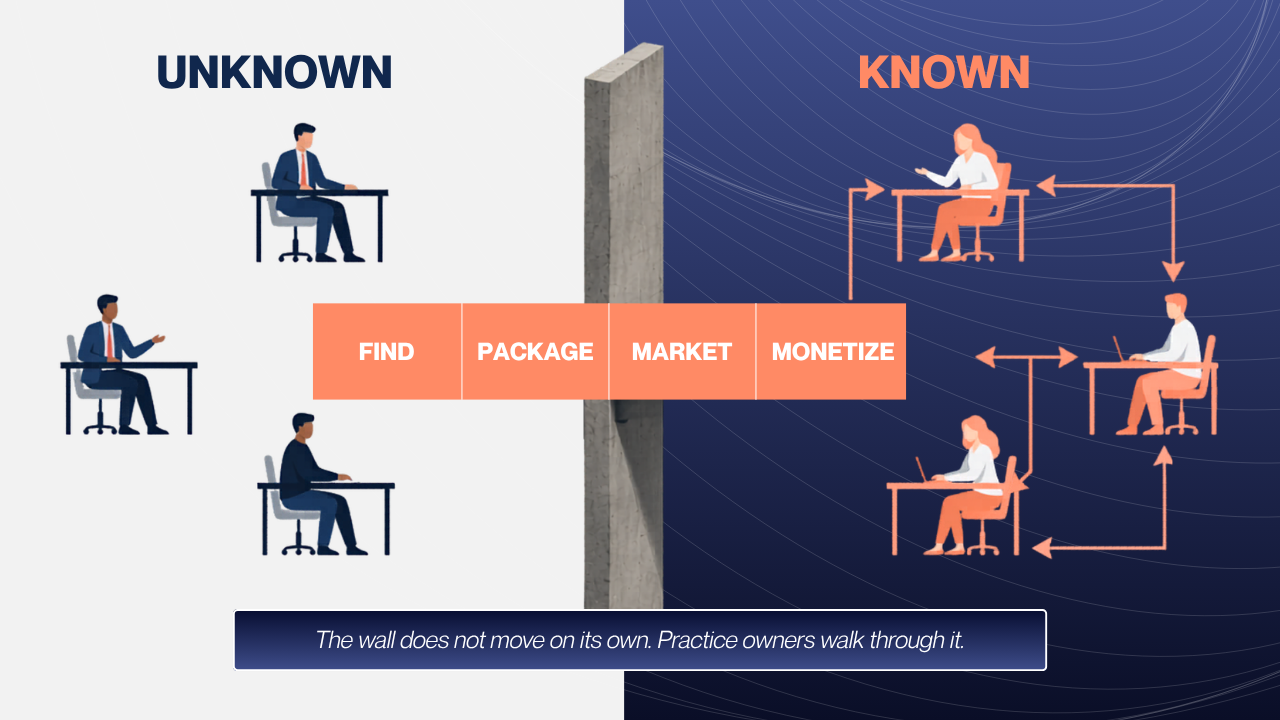
The diagnosis is direct. Read the questions below and answer honestly.
- If you stopped marketing for ninety days, would inbound deal flow continue, or would it stop?
- If a referral source mentioned you to a stranger, could the stranger find you, find your work, and find a clear way to invite themselves into your practice within ten minutes online?
- Does the market have a name for what you do, or do prospects describe you as a generic financial advisor when they talk about you to others?
- In the last twelve months, have you been invited to speak, contribute, or participate in something you did not have to ask for?
- When you walk into a room of two hundred peers, does at least a quarter of the room know who you are?
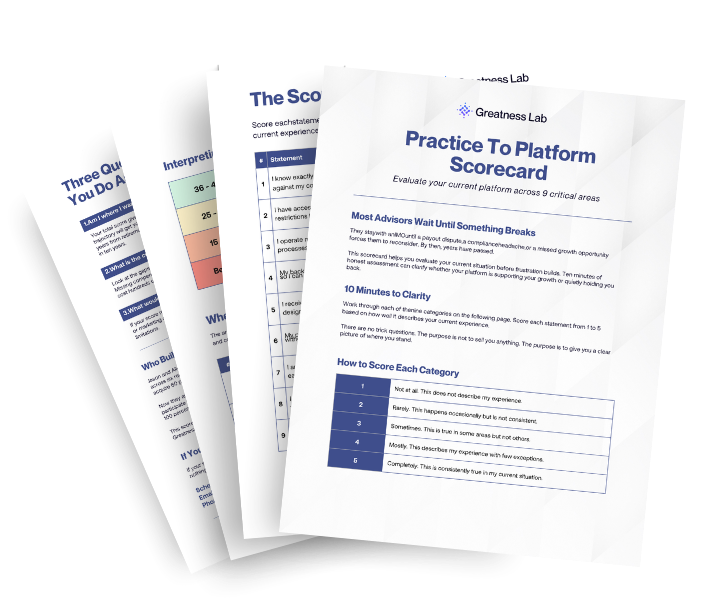
Most practice owners answer no to most of these. That is not a verdict on the work. It is a read on which side of the wall the practice currently sits on. Crossing the wall starts with naming the side you are on, then installing the disciplines that move the practice across. For a deeper read, run the structured ten-minute self-assessment on the Greatness Lab site.
If the diagnostic landed and the next question is what to do about it, the four disciplines below are the operating answer.
How to Cross the Wall: Find, Package, Market, Monetize
The crossing is a four-discipline installation. Each discipline does a specific job. None of them works without the others. Practice owners who try to skip a step end up with one or two of the four in place, and the deal flow that one or two disciplines produce, which is to say very little.
Find Your X Factor
The first discipline is find. You cannot package what you have not named, and you cannot name what you have not located. Most practice owners have an X factor in plain sight that they have stopped seeing because it has been there too long. The work is to find it again.
Useful questions: What is the one thing clients consistently say you do better than anyone else they have worked with? What is the one outcome you produce repeatedly that other advisors in your market do not produce? What has a colleague or a client said to you in the last two years that you brushed off because it sounded too generous, but kept coming back to mind? The X factor sits at the intersection of those three answers.
The discipline is unglamorous. It is sitting with the question long enough to find the honest answer, and being willing to commit to that answer publicly even before it feels finished. Most practice owners delay this step for years and call the delay due diligence. It is not due diligence. It is reluctance to be specific. And without that specificity, the practice cannot consistently attract clients in any one direction.
Package the Intellectual Property
The second discipline is package. Packaging is anything the prospect can feel, touch, taste, or see. A named system. A signature workshop. A book. A diagnostic. A landing page. A short video. A printed report. The work is to take the intellectual property the practice owner has in their head and put it into containers other people can engage with.
Naming is part of packaging. And naming is a leverage move. There are twenty-six letters in the alphabet that produce millions of words, and one of the most undervalued moves a practice owner can make is to give the work they already do a name worth saying out loud. The Annuity Operating System. The Financial Gym. Built to Lead, Built to Scale. A name turns work into an asset. The asset can then be marketed, taught, licensed, or built around. Without a name, the same work stays trapped inside the practice owner who does it.
The discipline is to look at the work the practice already does, give it a name with weight, and put the name on something the market can engage with within thirty days. The discipline is to ship the first piece of packaging the prospect can hold, instead of mapping a five-year publishing plan that never gets started. Packaging is what lets the practice attract clients without the practice owner being in the room.
Market Through a Distribution Rhythm to Attract Clients
The third discipline is market. And the market is where most practice owners assume they are stuck. They are not stuck on marketing. They are stuck on rhythm.
Marketing without rhythm is a lottery ticket. A one-time post on LinkedIn. A single podcast appearance. A single speaking engagement. None of it compounds. Marketing with rhythm is what builds reputational capital, because the market needs to encounter the practice owner in multiple contexts, across multiple channels, repeatedly, before the encounter graduates from impression to recognition to invitation.
Coach Burt walks his neighborhood every morning at six thirty and records a three-minute video. He has done this for years. The compounding effect is not the videos themselves, although those matter. The compounding effect is that operators in his network have come to expect the video, look for it, and quote it back to him in conversation. The rhythm became a reputation.
Speaking engagements work the same way. Even when the speaking is paid, the people in the room are the asset, not the fee. A practice owner who would prefer five hundred people to the speaking fee has understood the market discipline.
The discipline is to choose the rhythm and keep it. Three pieces of distribution a week, every week, in channels where the right buyers pay attention. Eighteen months of consistent rhythm produces what eighteen years of inconsistent posting cannot, and the practice begins to attract clients without active outreach.
Monetize the Reputational Capital Through Invitation
The fourth discipline is monetization. And the rule that governs it is the cleanest line in the framework.
|
“Where there is no invitation, there is no monetization.” |
Most practice owners who have built reputational capital still under-monetize, because they never close the loop. They are good at conversation. They are not good at conversion. They talk to people, post to people, share with people, and stop short of inviting people to a specific next step. The missing move is a specific invitation.
Invitation has to be specific. Come to the workshop. Schedule the strategy call. Join the platform. Read the book. Sit in on the next session. The invitation is the bridge between reputational capital and revenue, and without the bridge the reputational capital is anecdotal. Practice owners who are everywhere but never inviting build a brand that produces nothing financial. They build a presence that does not attract clients into the practice.
The discipline is to pair every piece of distribution with a specific invitation, and to make the invitation visible to the people most likely to accept it. The rhythm without the invitation is content. The invitation without the rhythm is a sales call. The two together ar
Return on Objective: The Reframe That Decides How You Spend Your Time
Practice owners who have read this far will recognize one of the recurring questions inside the framework. How much do I spend on the build, and what is the return I should expect to see?
The question is the wrong question. It is a return on investment question, applied to a return on objective situation.
The objective is to become known. The objective is to become known to the specific people who would buy from you, refer to you, hire you, partner with you, or invite you into deals. Once the objective is named that way, the math changes.
A coffee with the right referral source is not a cost. A morning video for the right audience is not a cost. A speaking engagement to a small room of qualified buyers is not a cost. None of it is a cost, because none of it requires capital. It requires time, and the discipline to point the time at the objective. This is a return on objective, and it is the lens that lets practice owners attract clients without spending money to do it.
Jason built Florida Financial Advisors with a cell phone and the willingness to call. Coach Burt built The Greatness Factory by walking into rooms and putting his message in front of whoever was there. Neither one bought their way to influence. Both pointed their time at the objective long enough that the objective got hit. The discipline is the same for the practice owner reading this, even if the channels and the audience are different.
Practice owners who internalize this reframe stop measuring marketing in dollars spent and start measuring it in proximity to the right people. The week reorganizes itself. The calendar reorganizes itself. The work that does not move you toward becoming known starts to come off the calendar, and the work that does starts to take its place. That is the operational shift the framework produces. And it is the shift that distinguishes the advisors who attract clients on rhythm from the ones who keep planning to.
The five ingredients can be acquired. The four disciplines can be installed. Coaching is the lever that closes the gap between knowing what to do and doing it on a rhythm long enough for the rhythm to compound. Practice owners who are working through this framework alone are doing it the slow way. The faster way is inside a coaching environment that holds the rhythm with the operator until the rhythm becomes who the operator is.
Frequently Asked Questions About How Financial Advisors Attract Clients
What is the difference between an advisor of influence and a center of influence?
An advisor of influence is a financial advisor whose own positioning, packaging, and distribution rhythm attract inbound deal flow directly to the practice. A center of influence is a third party professional, typically a CPA, attorney, business broker, or estate planner, who refers their own clients to a financial advisor as part of the working relationship between the two professionals. The two are complementary, not interchangeable.
A practice owner who has built influence in their own right also tends to attract better centers of influence relationships, because professionals in adjacent fields prefer to refer to advisors who already have visible authority. Building an advisor of influence is the upstream work. Building a center of influence network is the downstream compounding effect.
How long does it take to attract clients consistently as an advisor of influence?
Most financial advisors and insurance professionals who install the four-discipline framework consistently see measurable change in inbound deal flow within nine to eighteen months, depending on market size, packaging quality, and distribution rhythm.
The first six months produce mostly internal change. The practice owner finds the X factor, names it, builds the first piece of packaging, and establishes a distribution rhythm. The second six months are when the market begins responding. By month eighteen, practice owners who have held the rhythm typically describe a different operating experience entirely, with referrals, invitations, and qualified prospects arriving without active outreach. Practice owners who skip a discipline or break the rhythm extend the timeline indefinitely.
I am introverted. Does this framework still work for me?
Yes, the framework works for introverts, because the disciplines are operational and not personality-dependent. Find, package, market, and monetize do not require extroversion. They require specificity, consistency, and a willingness to make a specific invitation when the moment calls for one.
Many of the most influential practice owners in financial services are reserved in person and direct on the page. The packaging discipline favors written and produced work, where the introvert often has an advantage. The marketing discipline favors rhythm over volume, which suits the introvert who would prefer to produce one strong piece a week instead of performing on stage every day. The invitation discipline is a quiet, specific ask, not a loud pitch. The framework rewards consistency more than charisma, which is why introverts can attract clients as effectively as anyone else who installs the disciplines.
Do I need to write a book or start a podcast to attract clients as an advisor of influence?
No, a book or podcast is one packaging choice among many, and the right packaging depends on what your audience consumes and what you can produce consistently. A named workshop, a signature diagnostic, a quarterly white paper, a video series, a recurring email, or a small in-person gathering can all serve the packaging discipline.
The question is whether the packaging puts the practice owner’s intellectual property into a container the market can engage with, and whether the practice owner can produce it on a rhythm long enough to compound. A book that takes three years and never gets distributed serves less than a quarterly diagnostic that goes out on time for ten quarters in a row. The packaging discipline is about consistency and reach, not about prestige.
My niche is regulated and I cannot say much publicly. What does this look like for me?
A regulated niche shapes what you can publish but does not change the underlying framework. Practice owners in compliance-restricted environments build influence through specialized knowledge, demonstrated capacity, and consistent invitation, the same as advisors in less-restricted niches.
The published work tends to focus on educational content, frameworks, and decision-making guidance instead of specific products or returns. The packaging tends to be diagnostic tools, planning frameworks, and case-method content instead of testimonials or claims. The marketing tends to use channels where compliance review is part of the workflow, not a barrier. The invitation tends to be a strategy call, a planning conversation, or a structured discovery process. Practice owners in regulated niches who are doing this well are sometimes the most influential operators in their markets, because the constraints force them to build on substance instead of hype.
Stop Chasing. Start Being Chased.
The advisors who attract clients consistently were not born with influence. They built it. Five ingredients, four disciplines, and a rhythm long enough to compound. Practice owners who recognize the pattern in this article and decide to act on it are not at the beginning of a long climb. They are at the beginning of a specific install, with a specific operating sequence, that has been built and tested by practice owners who have crossed the same wall and learned to attract clients without chasing them.
The decision is not whether the framework works. It works. The decision is whether you are going to stay on the unknown side of the visibility line for another year, or start the install.
Ready to Cross the Wall?
The Greatness Lab community and coaching environment is built around the framework in this article. Schedule a conversation to explore whether the platform is the right fit for the practice you are trying to build.
About the Author
Jason Mickool, Founder and CEO of Greatness Lab
Jason Mickool built Florida Financial Advisors from a kitchen table conversation into a national advisor enterprise spanning dozens of locations across more than a dozen states. He completed a nine-figure transaction with AmeriLife and now applies that direct operating experience inside the Greatness Lab coaching and growth ecosystem, working with insurance and financial advisors who want to build, scale, and exit their own practices on their own terms. He is the author of Built to Lead, Built to Scale. Connect on LinkedIn.
Coach Micheal Burt, Co-Founder of Greatness Lab
Coach Micheal Burt is co-founder of Greatness Lab and founder of The Greatness Factory in Nashville, Tennessee. A former championship basketball coach turned business performance coach, he has worked with tens of thousands of professionals across financial services, healthcare, real estate, and entrepreneurship, and is the author of more than a dozen books including Person of Interest, Flip the Switch, and A to B. Connect on LinkedIn.