Many owners of insurance agencies and advisory firms reach a point where they are working harder than ever without seeing the same return from that effort. They can improve their sales skills, recruit more people, put in more hours, and keep pushing for growth. Eventually, though, there is a bigger question worth answering: can their insurance agency business model get them to the financial number they want?
Working backward from that number shows how the business would get there. How much production will it require? How many productive people will you need? What does each new person contribute after compensation and support? How quickly can you recruit and develop them? And can the infrastructure you have today support the organization you would need to build?
The answers can expose a problem that effort alone cannot solve. A business model may work extremely well at one stage and become harder to scale at the next. The economics may change as you add people. A recruiting model that worked with 20 people may not work with 200. A local market can run out of the candidates needed to sustain the same growth rate. Eventually, the numbers tell you whether you can keep building the same way or need to change how the business grows.
Testing your business model means starting with where you want to go, understanding what your current model would have to produce to get you there, and finding the constraints before you spend years trying to push through them.
Key Takeaways
- Working backward from your number shows the production, people, hiring, and time your business needs to reach it.
- Growth works when the production each new person adds creates enough margin to support the people and infrastructure behind it.
- Activity, conversion, case size, people, and weeks worked give you a way to forecast what your business model can produce, so you can plan ahead of the results.
- The same percentage growth gets harder to sustain as headcount, turnover, hiring needs, and infrastructure increase, so it pays to retest the model as you grow.
- When the math stops working, you can rebuild the model, adjust it, or use what you have built to reach greater distribution.
Testing Whether Your Insurance Agency Business Model Can Reach Your Goal
Your business model determines what happens when you apply more skill, effort, people, and capital to the business. It includes how revenue is generated, how products and services reach clients, how people are compensated, and what has to happen for the business to grow beyond your own production.
The test begins with your financial goal and target date. From there, work backward. If the business continues operating the way it does today, what would have to happen to reach that number? The answer might require more production from each person, a larger team, more locations, a different distribution strategy, or some combination of them.
Once you put numbers around those requirements, you can see whether the current model gives you a realistic path forward.
When Skill and Effort Run Into the Limits of a Business Model
“I’m a level ten person, but I’m stuck in a level four vehicle and I need to work on the vehicle.”
Coach Micheal Burt, Performance Coach and Founder of The Greatness Factory
Business owners can run into their own version of that ceiling. They may have a skill that sets them apart and more capacity to sell, lead, recruit, or develop people, while the structure around them limits how much additional value those abilities can create.
For an insurance agency or advisory firm owner, the question is whether the business provides enough room for those abilities to keep producing greater results. If doubling your effort would not materially change the outcome, it may be time to work on the vehicle itself.
Working on Your Business Model as Well as Your Mindset
Owners who want to grow often work on how they see themselves. One example is the shift from seeing yourself as a producer to seeing yourself as someone who builds a business. Testing the business model adds a second check. You look at whether the structure of your insurance agency or advisory firm can carry the growth you want.
At some point, most business owners face a choice between two paths:
- Keep optimizing the business you have. For an insurance owner, that often means finding new ways to sell more insurance. Those improvements can make you a better producer. Your growth still stays tied to what you sell yourself or add by hiring one person at a time.
- Design a business that can be built, grown, scaled, and sold. On that path, you start by seeing yourself as someone who could build that kind of business and, one day, sell it.
Looking at Your Insurance Agency Business Model as a Distribution Model
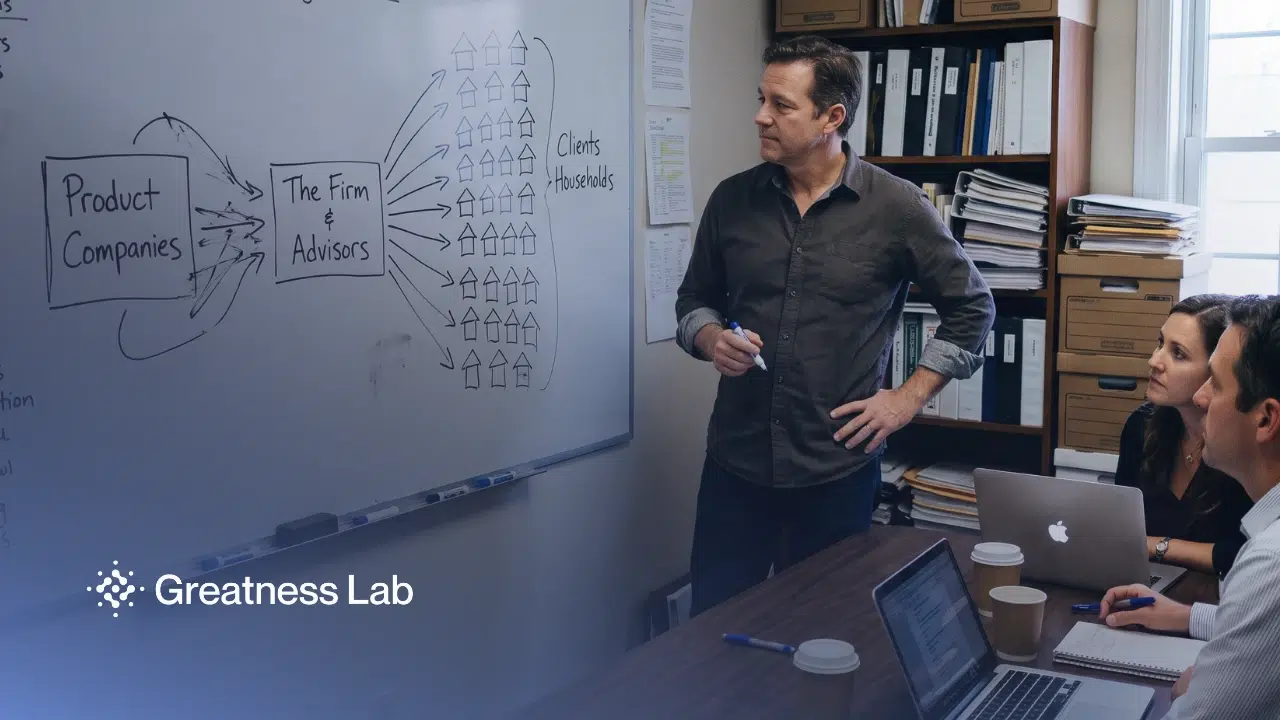
Many owners think first about the advice, wealth management, or insurance they provide. Another useful way to look at the business is through distribution: how the products and services you offer reach the clients who need them.
For insurance and many financial products, other companies manufacture the products. Your business model determines how those products and your advice reach more client households.
When you look at the business as distribution, you have a strategic decision to make about how you build it. You can build through retail or wholesale. The two models differ in three ways:
- Who you serve.
- Who controls the products and pay.
- What you need in place before the model works.
The retail example in this article is Florida Financial Advisors, the advisory firm led by Greatness Lab founder Jason Mickool.
Retail and Wholesale Distribution for Insurance Agencies Compared
|
What to compare |
Retail distribution |
Wholesale distribution |
|
Who you serve |
Client households directly |
Other business owners who already have many clients |
|
Who works with the clients |
Insurance agents or financial advisors you recruit, train, and develop, offering the products you choose in the way you choose |
Your partners, with their own clients, while you help them grow |
|
Who sets pay and margins |
You do, and you set them before you hire |
It depends on the agreement. In its joint ventures, Florida Financial Advisors owns a percentage of the partner’s business. It provides recruiting, training, and development support |
|
What you need in place |
A way to recruit, train, and develop people. Enough support for each new hire. A pay structure set before you grow |
Partners who already have client relationships. Recruiting, training, and development support they could not easily build on their own |
|
Example |
Florida Financial Advisors, which recruits, trains, and develops its own financial advisors |
Greatness Lab, which works with other owners as a wholesale partner |
Which model fits you depends on what you already have and what you want to build:
- Retail fits an owner who wants to lead a team. It also takes a willingness to build the recruiting and training system and the pay structure a team needs.
- Wholesale fits an owner who knows other owners with many clients. It also takes recruiting and training support those owners want.
The Cost of Being Caught Between Retail and Wholesale
Some owners never make the choice. They are neither wholesalers nor retailers, so they end up somewhere in between and execute neither model well.
If you choose retail, you own a business that recruits, trains, and develops people to serve clients on a large scale. You decide how people are paid. You also control which products your people offer and how they offer them.
Where you spend your time matters in retail as well. Some owners build by signing up downlines. They tend to spend their hours with people who bring in little business, and they earn little from that time. Owners who build retail well spend that time with people who show up to work and share their vision.
How Setting Pay Before You Hire Protects Your Margins in Retail Distribution
Hiring Without Taking On Financial Risk
Suppose you could hire someone and take no financial risk. You would keep between 40 and 50 percent of every dollar of revenue that person brought in. Most owners would want to hire as many people as they could.
What limits the number is infrastructure, meaning your process for recruiting, training, and developing people. When you hire faster than that process can support, retention tends to drop. The new people do not get the support they need. At Florida Financial Advisors, a manager who wants to hire 60 people at once hears no. One office cannot support that many new people.
How Florida Financial Advisors Keeps Financial Risk Off the Firm
The leaders of Florida Financial Advisors keep the financial risk off the firm in three ways:
- They define the commission. The firm pays commission at rates its leaders set. It takes no financial risk on anyone until that person has produced. A new financial advisor moves to $600 a week plus commission after earning $5,000 in commission. That takes about 20 weeks. By then, the person has written about $500,000 in product, so the firm has already made its money.
- They build in margin. The leaders build the firm’s margin into the product and service. On some sales the firm earns more and on others less, and the margin is there either way.
- They keep outside parties out of the split. Only the firm’s leaders decide how revenue is divided. Outside influence makes the arrangement hard to keep clear.
What does Florida Financial Advisors pay? The answer depends on the product, the client’s age, and the state. For that reason, each insurance agency or advisory firm works out its own pay structure. It is wise to review that structure with compliance and legal advisors before changing how people are paid. Running it as the team grows also takes accounting and reporting. That is why back-office infrastructure for commissions and compliance matters at scale.
Hiring at Volume When You Feel Too Busy
When you set pay before you hire and pay new people from what they produce, hiring at volume becomes easier, because a new person does not cost the firm money before producing. Once an insurance agency or advisory firm reaches about 10 people, many owners feel too busy to hire more. When Florida Financial Advisors reached that point, the firm hired another 10 people anyway.
The first 10 helped hire the next 10. By the time the firm had 20 people, the first group knew how to recruit. Each group then helped hire the next one. Over time, recruiting became part of everyone’s job in the firm.
Florida Financial Advisors could hire at that pace because two things were in place:
- Pay set before hiring. A new person did not cost the firm money before producing.
- A team that recruits. The people already on the team recruited alongside the firm’s leaders.
If you want to hire faster, check for those two conditions in your own insurance agency or advisory firm. Without them, each new hire costs you money up front, and the recruiting stays on you.
You may feel you do not yet know how to lead a bigger team. Having people to lead is often how owners learn, because experience tends to be the best teacher.
“If you don’t know how to lead people, then what you do is you surround yourself with a bunch of people to lead.”
Jason Mickool, Founder and CEO, Greatness Lab
How to Forecast Next Year's Production With the Success and Scale Formulas
A basketball coach with a strong program can often look at the season’s schedule and estimate the team’s wins. Business owners can bring the same discipline to growth. If you know the activity that creates opportunities, how often those opportunities convert, the value of the business produced, and how many productive people are working, you can begin to calculate what the model is capable of producing.
- A method that works the same way each time.
- A clear picture of what each person typically produces.
- People working inside a dedicated system.
Florida Financial Advisors uses two formulas to do that. The first measures what drives success at the individual level through its success formula. The second shows what happens when that performance is multiplied across people and time.
- Success formula: activity times conversion times case size. Activity is how many people you get in front of. Conversion is how well you turn those conversations into business. Case size is the value of each client relationship over time.
- Scale formula: the success formula times the number of people times the weeks they work.

These formulas turn your number into math you can work with. Start with the production you want to reach, then work backward to the output required per person, the number of productive people you need, and the recruiting required to build and maintain that headcount. Florida Financial Advisors uses the same activity and conversion math in both production and hiring, allowing its leaders to recruit and train financial advisors at scale and forecast results months before they show up.
Without a forecast, many owners run the business month to month. They see their financials about 90 days later. Only then do they ask their accountant whether they made money three months ago.
Why Scaling an Insurance Agency Gets Harder as It Grows
A business model can be highly successful and still become harder to scale as the organization gets larger. The question is whether the same growth mechanics still work at the size you have reached.
Florida Financial Advisors aims to grow headcount by 50 percent every year, with production tending to grow alongside headcount. Its experience also shows why the same percentage becomes harder to sustain at a larger size:
- Local markets can run short of candidates. In Florida Financial Advisors’ experience, offices tend to become harder to grow once they reach roughly 70 to 80 people. Its Tampa office, for example, has about 70 people. Growing that office to 110 becomes increasingly difficult as the available local candidate pool narrows. Rather than forcing all of that growth from the same market, the firm expands into markets such as Sarasota and Naples.
- Turnover grows with the team. At the same turnover rate, more people leave a larger team each year. The firm has to replace them before it adds anyone.

When the Growth Math Stops Working
Eventually, the required hiring can expose the limit in the existing growth model. Florida Financial Advisors reached that point when the math showed that adding about 700 financial advisors in a year, with turnover steady, would require almost 2,500 hires. The model had worked, and the firm had grown to a size where the same approach no longer added up. Its leaders responded by developing a new strategy: teaching other owners how to build and expand their own businesses.
A business built on the owner’s own time can reach the same kind of limit. When every client depends on your personal hours, working harder stops adding income once your calendar is full. Past that point, growth depends on the shift from producer to builder.
Has your insurance agency or advisory firm grown a good deal since you set up its business model? If so, it makes sense to test the model again. A growth rate and recruiting approach that worked at a smaller size may not hold at your current one.
Torch, Tweak, or Use: Your Options When the Business Model Falls Short
When your business model cannot get you to your goal, you have three broad options. You can torch it, tweak it, or use it. Which one fits depends on your situation:
- Torch it when no change inside the model you have would get you to your goal.
- Tweak it when the business is sound and you see a change in strategy that could open room to grow.
- Use it when someone else already has the distribution you need, and building it yourself would take much longer.
Torch It: Starting Over in a New Business Model
Tweak It: Making a Strategic Pivot Inside Your Current Business
When you tweak the model, you make a strategic pivot inside the business you already have. Owners choose this option when the business is sound. They see a change in strategy or offering that could help it grow.
Say your team already sells steadily. You can offer your clients another product that is good for them and carries strong margins. A product like that increases your share of each client’s spending. You can earn a good deal more in the same business.
Use It: Feeding a Bigger Partnership With Your Current Business
When you use the model, you keep your current business for what it does well. You let it feed something bigger. A coaching or advisory practice may never reach the owner’s biggest goal on its own. It can still bring a steady flow of leads and connections. A partner that already has people and distribution at scale can help the owner grow faster than building it all alone.
Owners take this route when someone else already has the distribution they need. Partnering at that point is the interdependent stage of business growth.
Partnering this way means bolting on to someone who already does what you want to do. You bring your skill to their business. You could build the same thing yourself, although that may take longer. When you bolt on, you can draw on the partner’s recruiting, training, and knowledge.
Wholesale partners work this way. Greatness Lab runs the Lab, a platform for independent insurance agencies and advisory firms. Owners can draw on its recruiting and training support and scale without giving up their independence.
A Business Model Check for Your Insurance Agency or Advisory Firm
Set aside an hour and answer these questions in writing. Your answers will give you a clearer picture of whether your current business model can reach your number.
- What is your financial goal, and by what date?
- What did your business produce in each of the last three years? If you kept running it as you do now, what would it produce by your target date?
- Are you building retail distribution, wholesale distribution, or are you caught somewhere in between?
- Who decides which products your people offer, how they offer them, and how they are paid?
- When you hire someone new, when does your business start carrying financial risk for that person?
- Could you estimate next year’s production from the number of people you will have and what each one produces?
- Has your insurance agency or advisory firm reached a size where your old growth rate is harder to hold?
- Based on your answers, which option fits: torch it, tweak it, or use it?
- What would need to be true for you to reach your goal with the model you choose? What is the first action you will take this month?
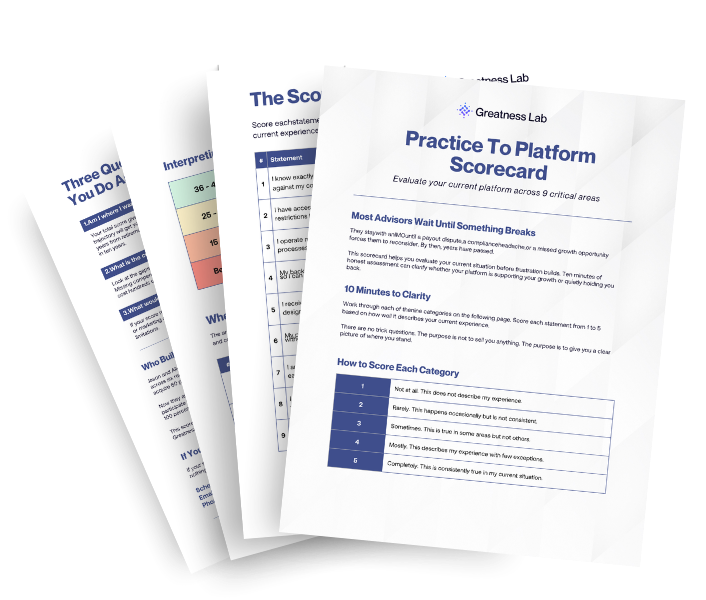
Would an outside view on your answers help? You can take the Practice Check-Up, a 10-minute scorecard. It compares your current setup with other options across nine areas that affect income, growth, and exit value.
Building an Insurance Agency or Advisory Firm That Can Reach Your Number
This test helps you see whether there is a credible path from the business you have today to the number you want to reach. If you can work backward from that goal and the production, people, hiring, economics, and infrastructure all support the path, you know what to build. If the math breaks along the way, you know where the model needs attention.
As the business grows, run the test again. A model that worked at one size can become the constraint at the next. Some owners work through those decisions alongside other owners at Greatness Lab’s live coaching sessions and events.
Test Your Business Model With Greatness Lab Tell us your number and how your business runs today. We will talk through whether your business model can get you there, and ways Greatness Lab could help if it cannot. |
Questions Owners Ask About Their Insurance Agency Business Model
What is an insurance agency business model?
What is the difference between retail and wholesale distribution for the owner of an insurance agency or advisory firm?
How can an insurance agency or advisory firm owner tell whether the business model is limiting growth?
Should an insurance agency or advisory firm owner rebuild the business or change strategy?
It depends on whether you can reach your goal inside the model you have. If no change inside it would get you there, you can torch the model and start over. If the business is sound, you can tweak it, such as by adding a product that serves clients well and carries strong margins. You can also use your current business to feed a bigger partnership when another organization already has the distribution or infrastructure you would otherwise have to build yourself. Martin Montana took that route to build his own financial advisory firm.
How can an insurance agency or advisory firm hire new people without taking on financial risk?
Why does growth get harder as an insurance agency or advisory firm gets bigger?
How do you grow an insurance agency when more effort stops moving the numbers?
Can an insurance agency or advisory firm owner run both retail and wholesale distribution?
About the Authors
Jason Mickool, Founder and CEO of Greatness Lab
Jason Mickool built Florida Financial Advisors from a kitchen table conversation into a national advisor enterprise. It grew to dozens of locations across more than a dozen states, and he completed a nine-figure transaction. Today he brings that operating experience to Greatness Lab. There he coaches insurance and financial business owners who want to build, scale, and exit on their own terms. He is the author of Built to Lead, Built to Scale. Connect with Jason Mickool on LinkedIn or at jasonmickool.com.
Coach Micheal Burt, Performance Coach
Coach Micheal Burt is a performance coach, best-selling author, and founder of The Greatness Factory in Nashville, Tennessee. A former championship basketball coach, he teaches the Prey Drive and Monster mindset frameworks to business owners and financial advisors. He partners with Greatness Lab as its Greatness Executive Coach. Connect with Coach Micheal Burt on LinkedIn or at coachburt.com.