You have been carrying a sales team that should already be carrying itself. You trained the producers. You wrote the processes. You stated the expectations, in some cases more than once. And the same problems keep walking back into your office on Monday morning. The same script falls apart in the same meeting. The same client objection trips up the same producer. You make the same correction for the third time, the producer nods, and within two weeks the drift starts again.
The instinct is to blame the producer, then the comp plan, then the hiring filter, then your own leadership. None of those is the real problem. The real problem is that no system holds the gap between what you trained your team to do and what they do in real client meetings. Without that system, the team drifts back to old behavior every time you stop watching, and you spend your week patching the same drift over and over. Training does not fix it. Comp does not fix it. Personality leadership does not fix it. The fix is structural.
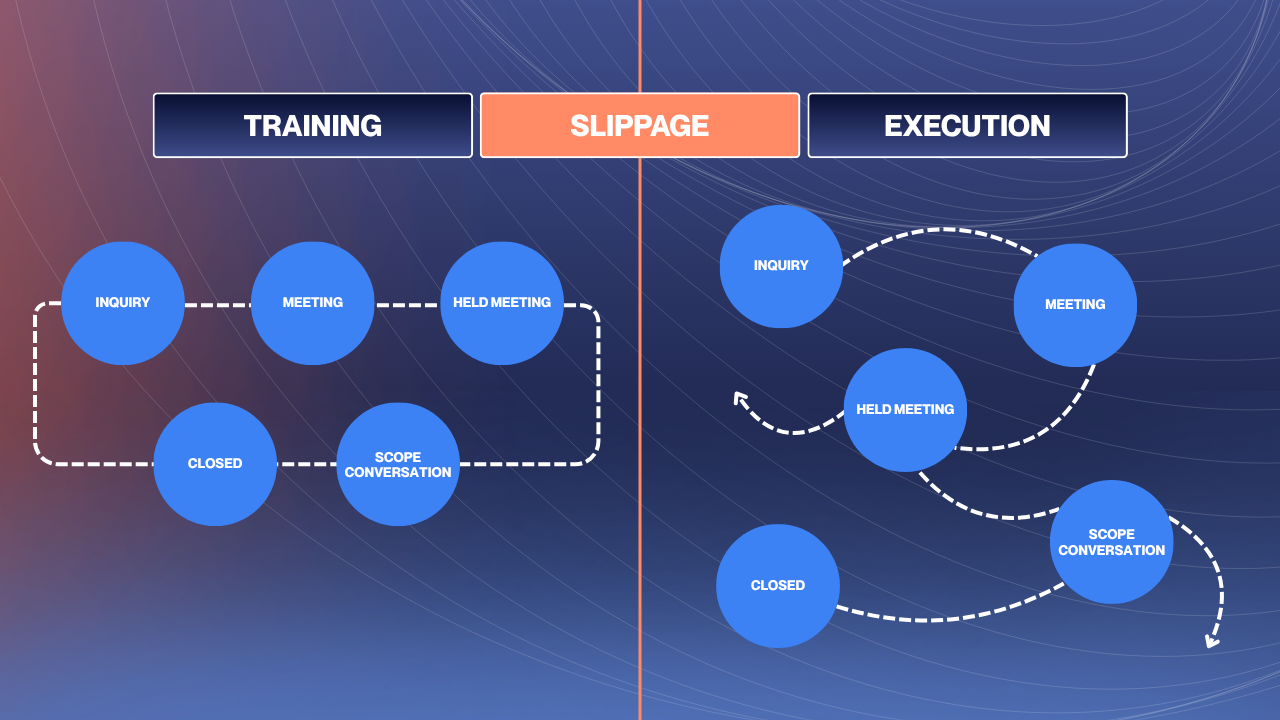
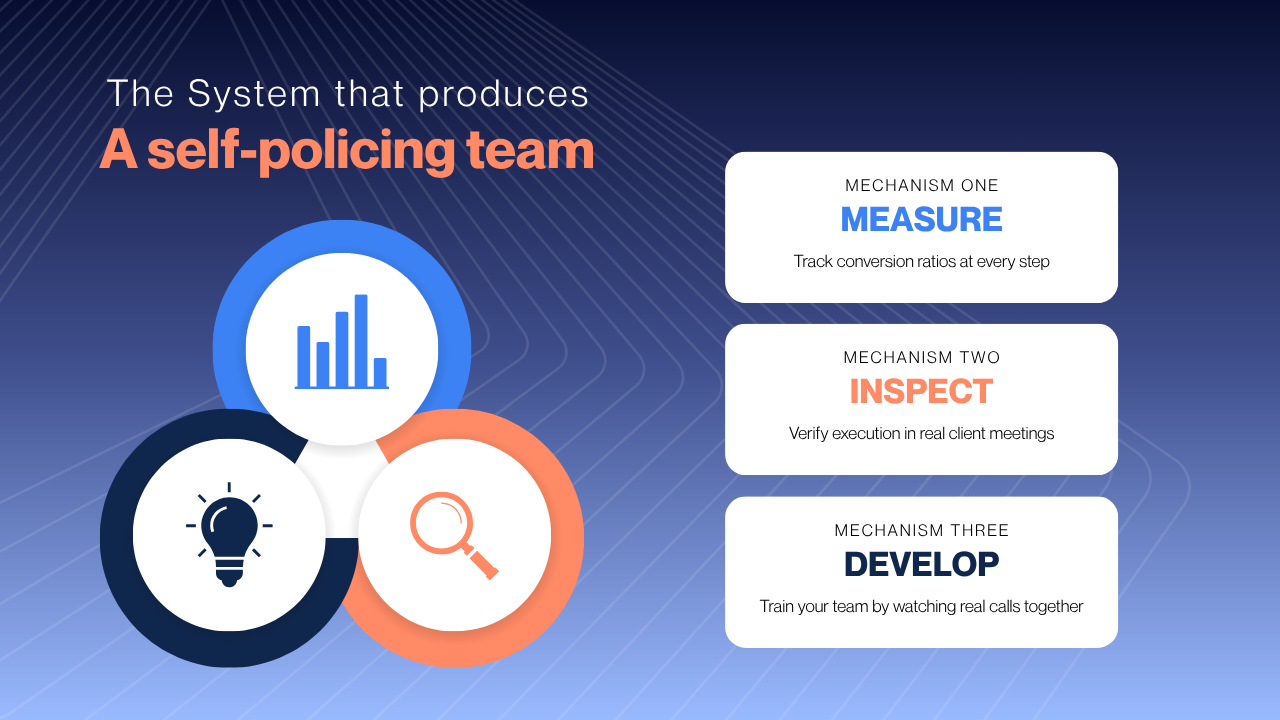
The gap has a name. Basketball coaches call it slippage, and three mechanisms close it: you measure slippage at every step of your sales process, you inspect execution in real conditions, and you develop your team in observation. This article walks through all three so you can install them inside your firm. The mechanisms turn your team into the enforcement layer you have been trying to be alone. The takeaways below summarize what changes when they go into place.
Key Takeaways
- Slippage is the gap between what you trained your team to do and what they do under real conditions. Most practice owners lose money to it for years before they name it.
- The fix is structural, not personal. Three operational mechanisms turn your team into the enforcement layer that holds when you look away.
- Mechanism one. Measure conversion ratios at every step of your sales process so the bottleneck becomes visible and addressable, not a vague feeling.
- Mechanism two. Inspect execution in real conditions with the line that does the work in six words. Let me watch you do it.
- Mechanism three. Develop your team in observation, not in isolation, so they learn from real client work instead of from rehearsals.
Why the Same Problems Keep Coming Back, and Why It Is Not Your Team's Fault
If you keep fixing the same problems on the same producer, you have probably convinced yourself the gap is a people problem. Maybe this hire was wrong. Maybe the producer is not coachable. Maybe the team needs a stronger personality leading them. The conversation in your head is almost always about who, when the answer is almost always about how. The language you use about yourself and your team shapes what you pursue and what you avoid, and the language is almost always wrong about where the gap lives.
First, consider what is happening when a producer drifts. A producer who trained on your sales process and is drifting on your sales process is not failing the training. The training did its job. The producer ran the script in the room with the trainer, demonstrated competence, and walked out understanding the play. Then the producer takes the play into a real meeting and a real client pushes back. They drop the script for the language they used before they trained. The meeting closes the way it would have closed without the training. The producer reports back that the call did not go well. You conclude the training did not stick. You run the training again. Two weeks later the producer slides again. You conclude the producer is the problem.
However, the producer is not the problem. The training is not the problem. The structural gap between training and execution is the problem, and it has a name.
What Slippage Is and Why It Costs Your Firm Money for Years
Coach Micheal Burt teaches a concept he carried over from his years as a championship basketball coach. Coaches use the term to describe what happens when a play looks clean in practice and falls apart in a game. The term is slippage, and Coach Burt brought it into his work with sales teams because the same mechanic plays out in advisory practices every quarter. He covers the broader frame of what activates teams in his Wall Street Journal bestseller Flip the Switch. This is a different concept from deal slippage, which is a forecasting term for opportunities pushed to later quarters. Training slippage is upstream of forecasting. It is the gap between training and execution that produces the underperformance forecasting tries to predict.
In practice, the coach stops the drill, walks out on the court, and runs it again. The team does not move on until the play looks the way it should. In the game, the coach is on the sideline and the players have to run the play themselves. The gap between what the team did in practice and what they do in the game is what slippage names. Every team has it. The teams that close it win at a rate that surprises their competitors. The teams that ignore it lose to slippage every quarter and blame the players.
Meanwhile, the same mechanic plays out in your firm. Your producer trained on a discovery script and drops it the second a real prospect pushes back. Your team trained on a follow-up cadence that collapses the moment one of them gets busy. You trained yourself on how to delegate and take the work back the first time something goes sideways. None of this is laziness or bad faith. It is the natural drift that happens when training happens in one room and execution happens in a different one. Nobody closes the loop between the two.
The cost of slippage is not just the deal that did not close. It compounds in three places:
- The producer who stopped believing the script worked, because they never ran it in the room where it was supposed to work.
- The team that learned what they could get away with when you were not watching. That is a culture lesson that scales every week the slippage continues.
- Your week. Three hours this week patching a bottleneck that has been bottlenecking for six months. The same three hours go next week unless the system changes.
|
The producer is not lying about what they did. They are telling the truth about what they thought they did, which is different from what happened. |
This article is about the system change. The three mechanisms below are the operational core of how Jason Mickool runs slippage correction across his businesses. Every one of them is built to do work that you have been trying to do alone, and to do it through your team instead of around them. They are part of the broader frame of the five components of an aspirational environment, and the slippage component is where most operators feel the cost earliest.
How to Close the Slippage Gap: Three Operational Mechanisms
Closing the slippage gap is not about more training, more pressure, or a stronger personality at the top of your team. It is about installing three operational mechanisms that turn your team into the enforcement layer the standard has been waiting for. The three mechanisms work together. Each one closes a specific structural opening that produces slippage. Together they take the work of holding the standard out of your hands and put it inside your firm’s operating rhythm.
Mechanism One: Measure the Slippage at Every Step of Your Sales Process
The first move is to stop calling slippage a feeling and start calling it a number. You know something is off. You cannot tell exactly where, because you have probably never broken your sales process into measured steps and watched the conversion ratios at each one.
Sales is activity times conversion times case size. When your revenue is off, the instinct is to pull harder on the activity lever because activity is the easiest one to see. You tell the team to make more calls, schedule more meetings, send more proposals. The activity moves and the revenue does not. The conversion ratios at each step of the process were the real problem. Now everyone is generating more bad-conversion activity than before.
The fix is to measure the conversion ratio at every individual step of your process:
- Inquiry to scheduled meeting
- Scheduled meeting to held meeting
- Held meeting to scope-of-work conversation
- Scope-of-work conversation to closed business
Each step has a ratio that should hold inside a known range. When one of those ratios drifts, the bottleneck is in that specific step, not in the producer’s general performance and not in the market. You do not have to fix the producer. You have to fix the step where the ratio broke.
Then run an example. Your first meeting was supposed to convert at two-to-one and is converting at four-to-one. That means your team is sitting through twice as many initial meetings to advance the same number of prospects. The slippage is in the first meeting. The follow-up is fine. The closing is fine. The training to re-run, the call to inspect, the script to check is the one in the first meeting. The diagnostic narrows the work from your team’s underperforming to your first meeting by dropping prospects on the floor. You know exactly which step to inspect. That is a six-month problem turned into a two-week problem.
When you build the conversion-ratio dashboard once, you stop chasing ghosts. Your team sees the dashboard, stops believing they are the problem, and starts seeing the bottleneck the same way you do. The ones who care about getting better start asking the right questions, which is the first sign that the system is starting to police itself. The dashboard sits inside a broader layer of operational infrastructure that your advisory practice needs as it scales beyond your direct reach.
Mechanism Two: Inspect in Real Conditions, Not in Trainings
The second mechanism is the one you probably say you already have and probably do not. The phrase will sound familiar. Inspect what you expect has been in management literature for decades, and most practice owners have heard it as a slogan more than as a system. Coach Burt teaches it as the operational mechanism that closes the gap, and the line that does the work is six words long. When a producer reports back that they tried something and it did not work, your response is let me watch you do it.
Most slippage is invisible until you ask the producer to demonstrate the play they claim they ran. The producer believes they ran the script. They believed it last Tuesday in the meeting and they believe it now in the debrief. The film tells a different story. They opened the conversation with the language they used before they trained. They handled the objection by talking around it the way they used to. They asked for the close with the apology in their voice that has always cost them the close. None of it registered for them in real time. It registers the moment they hear themselves on a recording, or watch themselves on Zoom playback, or run the play in front of you and you see what they cannot.
This is not punitive. It is structural. The producer is not lying about what they did. They are telling you the truth about what they thought they did, which is different from what happened. Inspection in real conditions closes the gap between intention and execution. It is the only mechanism that does.
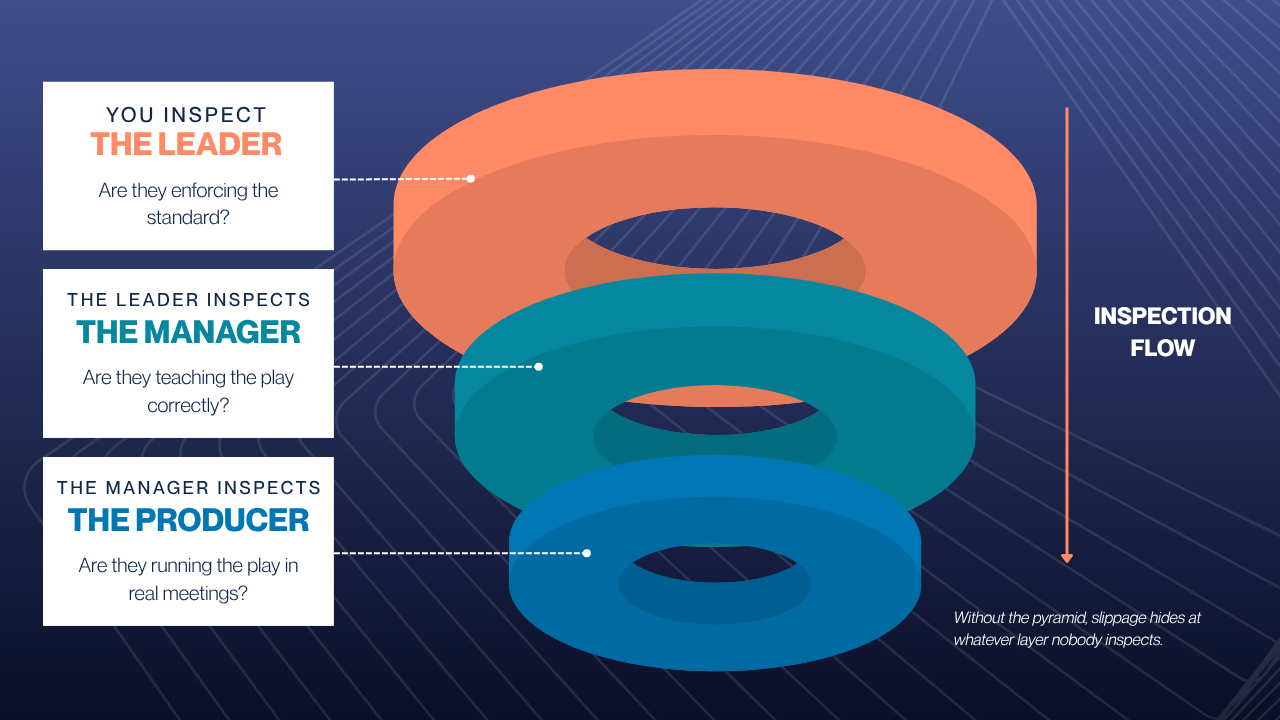
Furthermore, inspection has to happen at every layer of leadership, not just at the top. The pyramid runs three deep:
- The producer’s direct manager inspects what the producer is doing in real client meetings.
- The manager’s leader inspects what the manager is teaching and reinforcing with the producers.
- You inspect what the leader is enforcing across the team.
Every layer watches the layer below it. Without that pyramid, slippage hides at whatever layer nobody inspects, which is usually the one closest to the client. This is one of the things a real coach delivers that you cannot reliably deliver alone. A structured outside view closes the gap between what you think is happening on the floor and what is happening on it.
The norm to install alongside this mechanism is short and load-bearing. When somebody on your team reports back that they tried something and it did not work, your next sentence is great, let me watch you do it. The conversation that follows surfaces the slippage. The conversation closes the gap. Your team learns within ninety days that I tried that is not an acceptable end of the conversation. The language pattern itself starts producing better behavior. Nobody wants to be the one asked to demonstrate a play they cannot reproduce.
If the diagnosis in this article matches what is happening in your firm right now and the next step is not yet clear, a conversation with the Greatness Lab team works through the specifics of your practice without committing you to anything. Some practice owners find that a useful intermediate step before deciding what to do operationally.
Mechanism Three: Develop Everyone in Observation, Not in Isolation
The third mechanism is the one that turns a team of solo operators into a self-policing culture. Jason Mickool calls it Do Nothing Alone, and the application is simpler than most owners assume.
When one of your producers runs a real client meeting on Zoom, three or four other team members observe the meeting the way a coach watches film while it is happening. The operating rules are short:
- Cameras off.
- Mics muted.
- Notebooks open.
- No interruptions. The client does not see the observers.
- Debrief immediately after the meeting ends.
The producer hears what worked, what slipped, and what the observers would have done differently. The observers learn from a real call instead of a roleplay. You get a panoramic view of your team’s real execution patterns, not the cleaned-up versions that show up in coaching sessions.
The system works because experiential development is the strongest form of skill development that exists. Three groups learn at the same time:
- The producer running the meeting learns more in one debrief than in five training sessions, because the feedback ties to a specific moment in a specific call with a specific client.
- The observers learn more in one observed meeting than in five months of solo grinding, because they watch the play run live with consequences.
- And you get the panoramic view that lets you see how your veteran producers have drifted and what your new hire is absorbing before they ever run a meeting alone.
Teams that develop in observation stop hiding. The producer under observation cannot run the meeting on autopilot, which is the state where slippage breeds. The producer observing cannot disengage, because they are taking notes they will have to defend in the debrief. Everyone in the room is on the same play, in the same meeting, with the same context, learning the same lesson. That is the self-policing layer. The structure of the meetings builds it, not force of personality from the top.
There is a quieter effect underneath the system. The producer in the meeting does not always know whether five people are watching or one. Nobody runs autopilot when the observation could be happening at any time, and the team learns within a quarter that observation is just how the firm runs.
What Changes Inside the Firm in the First Ninety Days
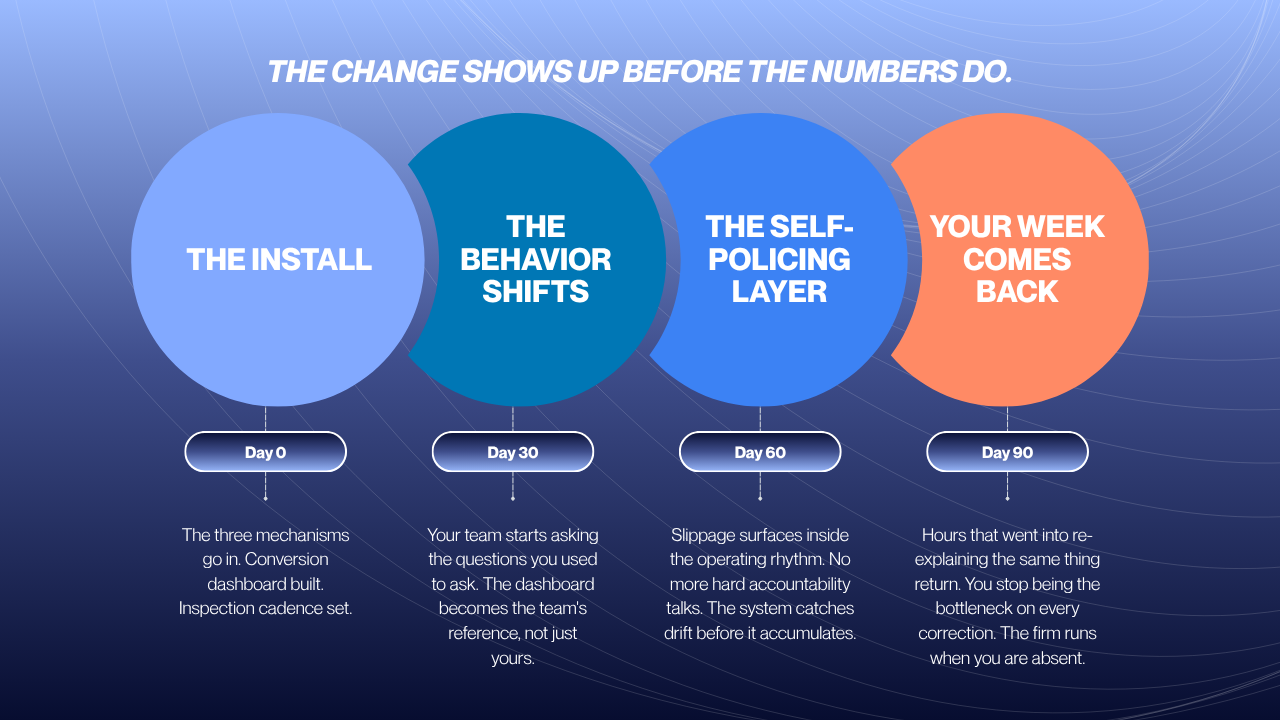
When you install the three mechanisms, you stop carrying the team and start running the team. The change shows up before the numbers do.
First: The Hard Accountability Talk Disappears
What disappears first is the conversation in your head about whether to have the hard accountability talk again. There is no hard accountability talk anymore. Slippage surfaces inside the operating rhythm of your firm, and your team corrects it before it accumulates into a confrontation.
Next: The Team Starts Asking the Questions You Used to Ask
The producer who used to defend a missed close starts asking the manager to watch their next call. The manager who used to overlook drift starts pulling up the conversion ratios at the weekly meeting. They want to see where the bottleneck is before you ask. Your new hire starts watching meetings before scheduling their first one, because that is what your firm does. The mechanisms install a different set of behaviors and your team starts running them without prompting.
Then: Your Week Comes Back
Hours you used to spend re-explaining the same thing to the same producer come back. You are no longer the only person watching execution. You are no longer the bottleneck on every correction. You are no longer the only voice asking let me watch you do it, because the question is now coming from every layer of leadership in your firm. The system is doing the work you used to do alone.
Jason Mickool has written about the longer arc in Built to Lead, Built to Scale. Scaling a business is not about the business. It is about becoming the person who can build a business that runs without being held together by your hands. The three mechanisms above are the operational beginning of that transition. When you install them, you stop being the operator who has to run every play and start being the architect of a system that runs the plays without you, which is the heart of the leadership development work that follows once the operating system is in place. Practice owners further along in that arc lean into the leadership transformation work that takes the operator-to-architect shift from a personal change into a firm-wide capability. If you want to see what the install looks like a year and three years out, read the success stories from advisors who have built this kind of system inside their own firms.
Common Questions About Slippage and Self-Policing Teams
What is the difference between sales training slippage and deal slippage?
Deal slippage is a forecasting term for opportunities pushed to a later quarter. Training slippage is the gap between what your producer was trained to do and what your producer does in the room. Deal slippage shows up downstream in your CRM. Training slippage lives upstream in the discovery call where your producer dropped the script the second the prospect pushed back. Confusing the two is expensive. Practice owners who cannot tell them apart spend money on the wrong fix. Forecasting tools, deal review meetings, qualification frameworks, and revenue operations consultants all address deal slippage. None of them touch training slippage, because training slippage does not live in your pipeline. The three mechanisms in this article fix the upstream problem. Better forecasting will not.
Will installing inspection make me the kind of leader my team resents?
No, if you inspect consistently and on a published rhythm. The leaders who become resented are the ones who inspect inconsistently, who inspect only when they are angry, or who use inspection as a setup for criticism instead of as a development practice. Producers who are coachable do not resent consistent inspection. They appreciate it, because most of them already know they have been drifting and have been waiting for somebody to call them on it. The producers who do a recent inspection are giving you information you needed before they became a Friday afternoon problem. They are telling you they are not coachable, or they are not bought into the standard the firm is holding, or they are running a version of the job they do not want to observe. None of those is something the firm can afford to leave unsurfaced. Inspect on a published rhythm so it is predictable. Inspect everyone so it is symmetrical. Make let me watch you do it the firm’s standard language so it is not your personal weapon. The team adapts inside a quarter.
My team is small. Will trying to install something this structured blow up the team I have?
No. Three to five producers is the easiest team size to install all three mechanisms in. Everyone can sit in on each other’s meetings without scheduling around it. You can ask me to watch you do it with any producer in any conversation. The conversion ratios for the whole firm fit on one page. Small teams blow up not from too much structure but from the absence of it. Without a measured conversion-ratio dashboard, your small team has only your mood as a signal of how things are going. Without inspection, your small team has only your exhaustion as the trigger for accountability conversations. Without observation-based development, your small team has the new hire learning by trial and error on real prospects. Those are the conditions where small teams break, not because the people are wrong but because the structure is missing. The mechanisms get harder to install when the firm grows past fifteen, not when it is small. Install them now while it is easy.
My producers will push back on being observed in client meetings. What does that pushback signal?
Pushback signals one of two things. The first is that the producer has been running on autopilot and observation will surface. They are not consciously hiding. They have just been operating in a mode where the client meeting was theirs alone and now it is not, and the discomfort of that change is real. Within ninety days they either lean in and start running the play correctly, or they decide your firm is not the right fit and self-select out. Both of those outcomes are good outcomes. The second is that you have framed observation badly. If observation has been positioned as punitive, surveillance, or a setup for criticism, the producer is correct to resist it. The fix is to position observation as your firm’s standard development practice, where every producer is observed and every observer becomes an observed producer in the next meeting. The exposure is symmetrical, which removes the punitive frame. Producers who still resist observation after that reframe are not telling you anything about the system. They are telling you something about themselves, and you need to know that information before it shows up as a missed quarter.
I have installed systems before and the team reverted inside six weeks. Why will this be different?
Most operational systems revert because they were installed as projects with a finish line. The team treats the rollout as a temporary disruption, you stop reinforcing it once the visible parts are in place, and your producers go back to running the version of the job they were running before. That sequence is not a failure of the system. It is the natural decay of any practice that depends on your energy to keep it alive. The three mechanisms in this article are different in one specific way. They install your team itself as the enforcement layer, not you. The conversion-ratio dashboard is visible to your team, not just you, so the team is asking the same questions about the bottleneck that you are asking. Inspection happens at every layer of leadership, not just from you down, so removing you does not remove the inspection. Observation-based development pulls the whole team into every meeting, so the standard is being held by everyone who watches, not just by you. The system polices itself because the team is the police. That is also why the install holds when you are on vacation, on a sales trip, or absent for any reason. Most systems break when you step away. This one does not, because you are not what holds it together.
Stop Being the Only Enforcer in Your Own Firm
You know which producer you were thinking about by paragraph three. You know which step in your sales process is the one that has been slipping. You know which Friday afternoon conversation has been getting postponed for four months. That recognition is enough to start. Practice owners who have already walked this arc share their work in the Greatness Lab success stories if you need to see what the system produces in firms like yours.
What changes inside the firm when the three mechanisms install:
- You get your week back. Hours that used to go into re-explaining the same thing to the same producer come back.
- Your team starts asking the questions you used to have to ask. Conversion ratios get pulled up at weekly meetings before you bring them up.
- Your new hire learns by watching, not by trial and error on real prospects. Experiential development replaces the cost of hiring mistakes.
- Slippage gets surfaced inside your operating rhythm, not in confrontations. There is no hard accountability talk anymore because the system catches drift before it accumulates.
- Your firm runs when you are absent. The system is the enforcement layer, not you. Vacations, sales trips, and surgery do not break it.
Done Carrying the Team Alone? The Greatness Lab was built for the operational install, not for inspiration. The three mechanisms in this article are how the work gets done inside the membership. See how the install works inside Greatness Lab Membership For insurance and financial advisors ready to stop being the only enforcer in their own firm. |